

Knowledge Forum Explores Japan’s Leadership in Global Health in an Era of Declining Global Aid
2026.04.07





Updates from JICA Ogata Research Institute on the latest events, publications and more.
RegistrationHow to Find Us


On Feb. 4, 2026, a Knowledge Forum on global health was jointly organized by the JICA Ogata Sadako Research Institute for Peace and Development (JICA Ogata Research Institute) and the Japan Center for International Exchange (JCIE). It brought together policymakers, researchers, development partners and private-sector leaders to discuss Japan’s role in global health amid declining international aid.
In his opening remarks, Oba Yuichi, Ambassador for Global Health Diplomacy, Ministry of Foreign Affairs of Japan, emphasized that health is not only a humanitarian concern but also central to economic stability, social cohesion, and national and international security. He argued that the fundamental human aspiration to protect the health and dignity of our loved ones should be a universal value that unites the international community. Against a backdrop of declining public funding and growing geopolitical uncertainty, he stressed the need to strengthen global health cooperation, reaffirming Japan’s commitment to working hand in hand with partners in the Global South. This requires a tailored approach to their needs and multilayered support through multilateral, bilateral and private channels to support self-reliant progress toward universal health coverage. He concluded his remarks by calling on everyone to champion global health initiatives to achieve human security, while protecting the lives and dignity of every individual and building a future where no one is left behind.
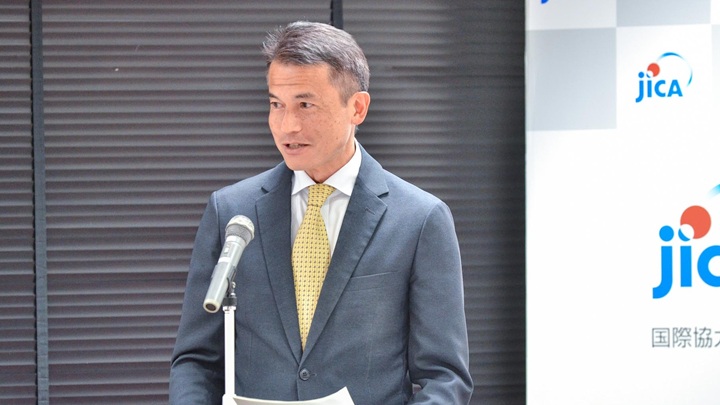
Oba Yuichi, Ambassador for Global Health Diplomacy, Ministry of Foreign Affairs of Japan
In his keynote address, Omi Shigeru, Chairman, Board of Directors of Japan Anti-Tuberculosis Association (JATA), who holds multiple national and international roles, noted that declining engagement by major donors is already harming global health efforts, particularly in communicable disease control. Drawing on his previous work with tuberculosis (TB), he highlighted shortages of medicines and diagnostics, weakened surveillance capacity, and the persistent misconception that TB is a disease of the past, despite remaining the leading infectious killer of adults outside the COVID-19 years.
He stressed that pandemics and infectious diseases must be understood as national and global security concerns, given their profound social and economic consequences. Describing the current international environment as increasingly fragmented, with a “my-country-first” mindset being spread across countries like infectious diseases, he warned that reduced solidarity undermines collective preparedness and response.
Turning to Japan’s role, and drawing on his many years of work with the World Health Organization (WHO), Omi shared his view that Japan’s long-standing contribution to global health is highly regarded by the international community. This can be seen in its strong track record and characteristics unique to Japan’s cooperation. He cited the importance of maintaining long-standing networks with many countries developed through bilateral support. This comes in addition to the support provided through multilateral channels, as well as the context-sensitive approach to individual country needs and technical support provided on the ground by Japanese experts based on the principle of equal partnership.
Looking ahead, he presented principles for future cooperation which included the delivery of tangible outcomes, accountability to Japanese taxpayers, a focus on proven experience and expertise, public-private-academic collaborations, respect for the changing role of partner countries, and the coordination of support with the international community. He also listed pandemic preparedness, universal health coverage (UHC), and comprehensive non-communicable disease (NCD) control as priority areas for the future.
Omi stressed the need to remember that through JICA and multilayered support in the past, Japan has gained many friends around the world. He argued that sustaining public support for development cooperation requires patience, continuous engagement, and down-to-earth efforts of reaching out to those who do not understand its value. Taking the current world, characterized by fragmentation, as a potential opportunity, he called for even stronger leadership by Japan, including the need for increased investment in global health as part of national security efforts.
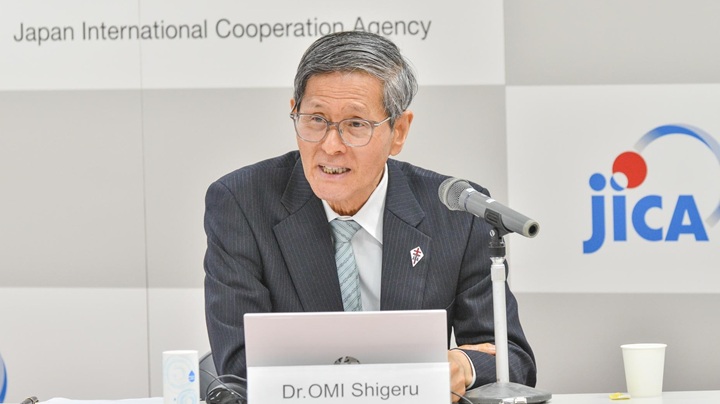
Omi Shigeru, Chairman, Board of Directors of Japan Anti-Tuberculosis Association
The keynote session was followed by a panel discussion, moderated by Takizawa Ikuo, Principal Research Fellow, JICA Ogata Research Institute, and featuring panelists Itoh Satoko, Managing Director, JCIE; Patrick Kuma-Aboagye, former Director General, Ghana Health Service; Nakagawa Sachiko, Managing Director of the Japan Pharmaceutical Manufacturers Association (JPMA); and Shibusawa Ken, Chief Executive Officer, Shibusawa and Company, Inc. Takizawa encouraged the panelists to reflect on Japan’s role in health in the face of a changing global landscape, and consider what future cooperation involving diverse partners should look like. It would need to leverage Japan’s strengths while ensuring both the sovereignty of countries and the solidarity of the global community.
Speaking online from Ghana, Kuma-Aboagye stressed the importance of international cooperation amid growing global interconnectedness, while emphasizing the need for country ownership and locally driven strategies. He noted that development assistance for health has significantly improved outcomes in the Global South, pointing to Ghana’s major advances in infectious disease control, vaccination and maternal and child health.
Kuma-Aboagye warned that declining official development assistance (ODA) risks reversing these gains by threatening essential health services. In response, governments are mobilizing domestic resources, improving efficiency through digitization and procurement reforms, strengthening primary health care, expanding South-South cooperation and public-private partnerships. He described Japan as “ticking all the boxes of an ideal partner,” because of its support for health systems and primary health care (PHC), aligned with country priorities, and provided through a co-creation approach. He shared examples of Japan’s support for the Noguchi Memorial Institute for Medical Research as an iconic demonstration of capacity development and collaboration on maternal and child health record books.
Reflecting on changes in development agendas from sector-wide approaches (SWAPs), the Lusaka Agenda and now the Accra Reset, Kuma-Aboagye reiterated the value of Japan’s ODA, which involved sending experts and volunteers on the ground, encouraging Japan to continue its work on PHC and health systems strengthening for UHC and to maintain a relationship based on mutual trust.
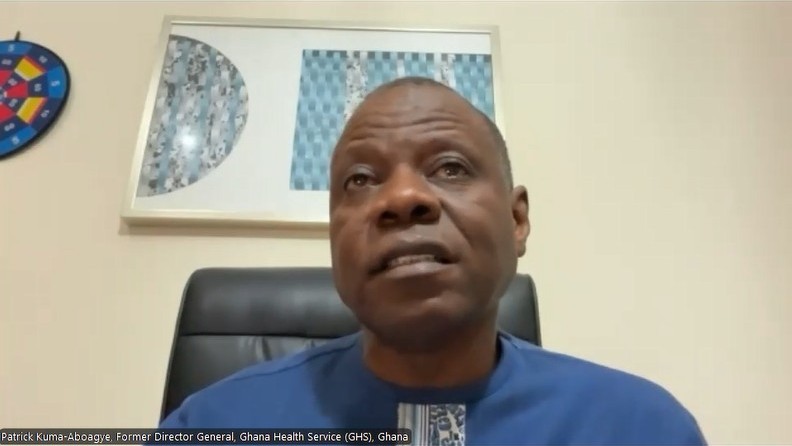
Joining online, Patrick Kuma-Aboagye, Former Director General, Ghana Health Service, takes part in the panel.
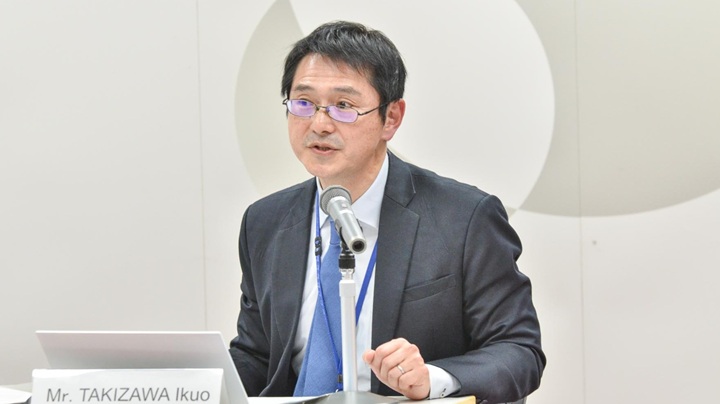
Takizawa Ikuo, Principal Research Fellow, JICA Ogata Research Institute, moderates the panel discussion.
In her comments, Itoh observed that Japan’s commitment to global health has expanded enormously over the past 25 years, a trend shared by other G7 countries since around 2000. She noted that Japan is widely recognized for its major contributions to global health and that this work has become an important source of Japan’s soft power. Itoh argued that the primary driver of this progress in global health has been multi-stakeholder collaboration in Japan, which increased the visibility of the global health constituency in the eyes of the Japanese policymakers.
Regarding the current trend toward aid cuts, Itoh noted two different views among policymakers: that Japan should step up to fill emerging gaps, or that health ODA should be reduced in line with other G7 countries. Rather than choosing between them, she argued that Japan should combine them by prioritizing the goal of health equity and not necessarily Japan’s visibility, adopting a carefully targeted approach to health sovereignty that reflects different country contexts. She also advocated the need to develop new health funding sources by engaging with the private sector and philanthropists, establishing new modalities such as blended finance and health tax, and reviewing the sectoral balance of Japan’s ODA.
Reflecting on the recent cut in Japan’s contribution to the Global Fund, she argued that funding—particularly through multilateral organizations, along with agenda-setting capacity, innovation, and trust—is essential for Japan, or any country, to be recognized as a leader in global health. She also stressed that everybody in the global health community must take up the leadership and increase the visibility of Japan’s efforts to the people around the world.
Shibusawa explained that the Impact Investment Initiative for Global Health (III) was endorsed at the G7 Hiroshima in May 2023. The III aims to complement ODA by mobilizing private-sector finance across the global health value chain, and to provide historical perspectives on his earlier work through the Coalition of Business Leaders Promoting Global Health in 2019. He described impact investing as for-profit investment with a clear intention to deliver social and environmental solutions, stressing that intent and discipline in defining impact are essential.
Shibusawa outlined the initiative’s strategic pillars as outreach to expand awareness, impact measurement and management (IMM), and policy recommendations to governments. He noted the rapid growth in membership from 37 to 124 in December 2025, while acknowledging that participation remains concentrated in the Global North and calling for greater engagement from the Global South. He cited early examples of successful investor-startup linkages, while stressing that private capital alone is insufficient and must be supported by government policy and incentives to achieve meaningful global health impact.
He also emphasized the importance of blended financing to de-risk and encourage more private-sector investment, as well as the need for the global health community to go beyond preaching to each other and make a conscious effort to engage more people, because of its importance for the next generation. He shared his idea of incorporating a health corridor within the Free and Open Indo-Pacific (FOIP) where investors, corporations and startups can play their roles.
He concluded his remarks by calling people to fight the dark side, “me-first” mentality currently gaining ground around the world.

Itoh Satoko, Managing Director, Japan Center for International Exchange (JCIE)
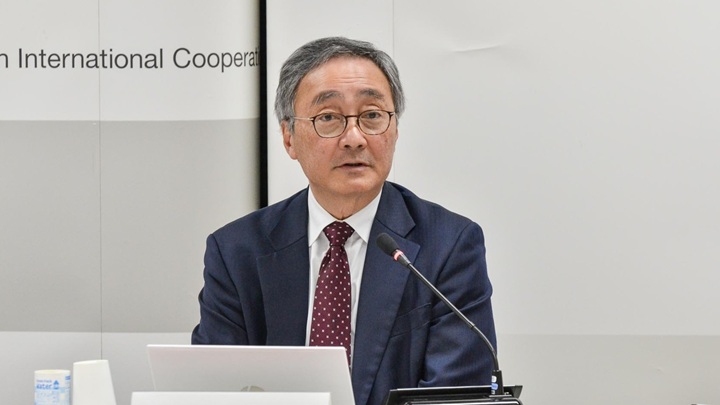
Shibusawa Ken, Chief Executive Officer, Shibusawa and Company, Inc.
Nakagawa noted that innovation makes a real difference when it is designed to reach people through strong partnerships, effective delivery strategies, and resilient supply chains, especially as co-creation with low- and middle-income countries (LMIC) becomes increasingly important.
Nakagawa highlighted contributions by Japanese pharmaceutical companies across neglected tropical diseases (NTDs) , emerging infections, tuberculosis, antimicrobial resistance (AMR) and COVID-19. These contributions include child-appropriate formulations for schistosomiasis treatment, an mpox vaccine advanced through global emergency pathways and coordinated donations, and a dengue vaccine achieving broad approvals in endemic countries. There are also new treatment options for multidrug-resistant tuberculosis (MDR-TB) and novel antibiotics, and the development of oral antivirals for COVID-19 that have been licensed widely to LMIC manufacturers. These examples, she emphasized, are not isolated product stories but demonstrate how R&D can be linked with delivery so that innovations ultimately reach patients in the world. She also shared JPMA’s work engaging youths at the World NTD Day event to motivate future scientists and policymakers.
She concluded by highlighting some future directions, including the advancement of innovation for unmet medical needs, co-creation of resilient supply chains involving LMIC manufacturers, strengthening multi-stakeholder collaboration through long-term partnerships, expansion of access and support for UHC, and shifting from aid to co-creation with LMICs as equal partners in innovation. She pointed out that local manufacturing is not simply a matter of building a factory; it depends on an entire ecosystem that incorporates regulatory capacity, compliance and quality control. She also expressed her enthusiasm for sharing Japan’s success in achieving the world’s longest healthy longevity through UHC with the rest of the world.
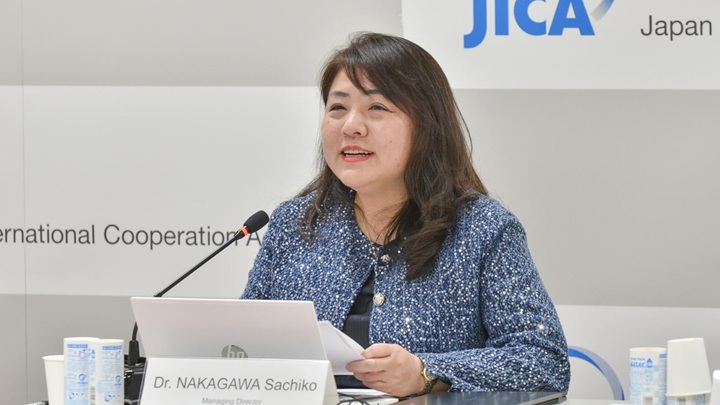
Nakagawa Sachiko, Managing Director of Japan Pharmaceutical Manufacturers Association
In her closing remarks, Kamei Haruko , Director General, JICA Ogata Research Institute, underscored that global health stands at a pivotal moment amid slowing SDG progress, declining ODA and deepening geopolitical fragmentation. She emphasized that even in this challenging environment, trust, country ownership, innovation and private-sector engagement remain strong, reaffirming JICA’s commitment to advancing human security and co-creating a more resilient and sustainable global society.
A video recording of this webinar can be watched on the link below.
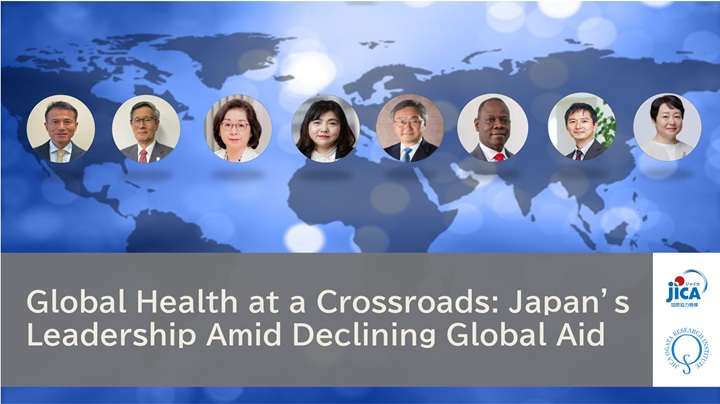
Seminar | Global Health at a Crossroads: Japan’s Leadership Amid Declining Aid (Knowledge Forum)
Sns share!



事業事前評価表(地球規模課題対応国際科学技術協力(SATREPS)).国際協力機構 地球環境部 . 防災第一チーム. 1.案件名.国 名: フィリピン共和国.
事業事前評価表(地球規模課題対応国際科学技術協力(SATREPS)).国際協力機構 地球環境部 . 防災第一チーム. 1.案件名.国 名: フィリピン共和国.
事業事前評価表(地球規模課題対応国際科学技術協力(SATREPS)).国際協力機構 地球環境部 . 防災第一チーム. 1.案件名.国 名: フィリピン共和国.
事業事前評価表(地球規模課題対応国際科学技術協力(SATREPS)).国際協力機構 地球環境部 . 防災第一チーム. 1.案件名.国 名: フィリピン共和国.
事業事前評価表(地球規模課題対応国際科学技術協力(SATREPS)).国際協力機構 地球環境部 . 防災第一チーム. 1.案件名.国 名: フィリピン共和国.


