

Book Launch Seminar for “A History of Japan and South America, Connected by Migration”
2026.07.29







Updates from JICA Ogata Research Institute on the latest events, publications and more.
RegistrationHow to Find Us


As the final outcome of the research project “A Transnational History of Japanese Emigration to South America: Migration Programs, Economic Development, and Cultural Activities ,” the book “A History of Japan and South America, Connected by Migration ” (available in Japanese only) was published. To mark this occasion, a book launch seminar was held on March 12, 2026, by the JICA Ogata Sadako Research Institute for Peace and Development (JICA Ogata Research Institute).
This book revisits modern and contemporary transnational history through a focus on Japanese emigrants and their descendants (who are often referred to as the Nikkei). It examines their experiences from the perspectives of both Japan, the sending country, and South American countries, the receiving countries. In addition, it explores the realities of migration programs, including pre-departure-education and colonial migration programs, which were implemented through collaboration between state and private agents. Pre-departure education programs were designed to prepare migrants for smooth transition into the receiving countries and to foster a sense of Japanese national identity.
In his opening remarks, Mine Yoichi , Executive Director, JICA Ogata Research Institute, noted the long history of migration that has connected Japan and South America, highlighting that 2026 marks the 140th anniversary of Japanese migration to Argentina. He referred to a comment from one of the editors of the book, which notes that the friendship cultivated by people moving between Japan and South America, despite the great distance between them, can be further strengthened by learning from history. Mine expressed his hopes that the seminar discussions would serve as a catalyst to deepen these connections.
Facundo Garasino , Specially Appointed Lecturer, Global Japanese Studies Education and Research Incubator (GJS-ERI), University of Osaka (and former Visiting Fellow, JICA Ogata Research Institute), served as the chief of the research project and one of the editors of the book. In his presentation, he provided an overview of the book.
From the late 19th century to after World War II (WWII), Japan was a country of emigration, sending its people to Hawaii, South American countries (e.g., Brazil) and other parts of the world. However, migration policies and the experiences of migrants have often been overlooked in narratives of modern and contemporary Japanese history, a point Garasino highlighted with concern.
He explained that the book aims to reposition Japanese emigrants in South America as active agents of history who have served as bridges between Japan and the region. It seeks to clarify how their migration and their activities at their destinations connected Japan and South America, what kind of influence was exerted by the goods, crops, capital and technology that they brought along with them, and what roles they played within their destinations.
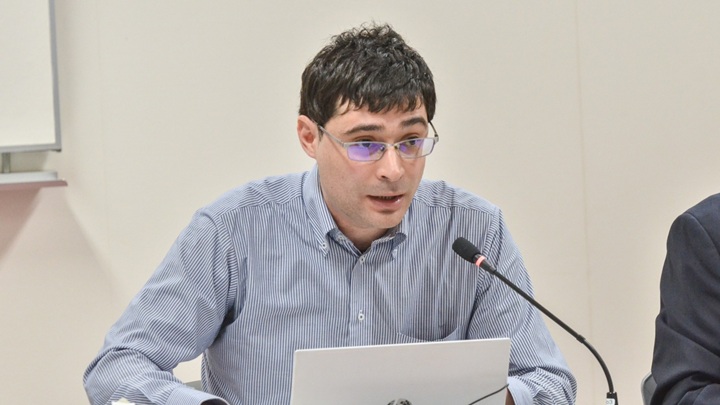
Facundo Garasino, an editor of the book (and former Visiting Fellow of the JICA Ogata Research Institute)
Two experts gave comments under the facilitation of Takaki Kana, Associate Professor, Institute for Liberal Arts (ILA), Institute of Science Tokyo, who is the other editor of the book.
Ohkuma Tomoyuki, Associate Professor, University of Kitakyushu, and an expert of modern Japanese history, remarked that the book analyzes migrants from transnational-history perspectives as agents of history, going beyond understanding at the nation-state level and comprehensively looking at the sending country (Japan) and the receiving countries.
Ohkuma further observed that by asking what immigrants had brought to each local community, the book highlights the need to revisit the relationships between the local communities and the individuals and activities that shaped them. He also pointed out the importance of paying attention to cases where emigrants were sent abroad independently of initiatives by local communities.
Ohara Manabu, Senior Advisor, JICA (and former Director General of the Latin America and the Caribbean Department of JICA), commented from the perspective of post-WWII Japanese migration. He shared the continuity from pre-WWII migration to post-WWII migration that led to development cooperation despite some changes in philosophy, and the efforts made by the Japan Emigration Service (JEMIS)—one of the predecessors of JICA—to assist smooth immigrant settlement. Ohara then pointed out that the perspective of evaluating migrants as the agents of development is important but may obscure the difficulties and vulnerability migrants themselves experienced.

Ohkuma Tomoyuki, Associate Professor, University of Kitakyushu

Ohara Manabu, International Cooperation Specialist, JICA (and former Director General of the Latin America and the Caribbean Department of JICA)
In the discussion session held under the theme “Japan and South America, Connected by Migration,” Takaki first shared her experience joining a festival in 2014 that commemorated the 60th anniversary of the settlement of Japanese immigrants in Colonia Okinawa (Okinawa Uno), Bolivia. She commented that as seen with the Worldwide Uchinanchu Festival, Okinawa still maintains strong connections with Okinawan emigrants and their host communities. Takaki then reflected on a student at a Japanese language school in Colonia Okinawa who left a strong impression on her. In an essay, the student expressed her desire to preserve the Okinawan language. Takaki added that migration and Nikkei communities are not merely matters of the past but are strongly relevant to our future.
Namura Yuko, Part-time Instructor, Center for Japanese Language, Waseda University, authored Chapter 2 “Educating Emigrants: The Overseas Colonization School and Its Graduate Network in Paraguay.” Drawing on her experience as a JICA Volunteer (also known as Japan Overseas Cooperation Volunteer) at a Japanese language school in Paraguay, she reflected that although she carried JICA’s philosophy with her, she was perceived by local residents as an immigrant. Namura explained that this experience made her question why Nikkei communities that preserve Japanese culture exist in Paraguay, a country geographically distant from Japan, and this curiosity ultimately inspired her research. She noted the importance of conducting research that carefully considers the position and intention of each stakeholder.
Negawa Sachio, Specially Appointed Researcher, International Research Center for Japanese Studies, authored Chapter 1 “Collaboration in Programs for Japanese Emigration: The Role of Local Agents of the Kaigai Kōgyō Kabushiki Kaisha.” In his comments, Negawa focused on the relationships between various stakeholders and migrants within migration programs. Drawing on examples such as the sense of rivalry among different regions in Japan that sent out emigrants, as well as the awareness of prefectural identity fostered when living spaces on emigrant ships were allocated according to the regions of origin of emigrants, Negawa suggested that these experiences may have contributed to the formation of regional identities based on the places of origin of migrants. He noted that this may help explain the later establishment of “kenjin kai” (groups of migrants from the same Japanese prefecture) in migration destinations.
Chapter 3 “Emigration as Salvation: Christianity and Migration in the Strivers’ Association” was authored by Felipe Motta, Assistant Professor, Kyoto University of Foreign Studies. Using the Strivers’ Association (Nippon Rikkokai)—an institution founded on Christian principles that provided guidance for overseas migration—as an example, Motta explained how experiences in schools established in Japan without regional roots to prepare individuals for overseas colonial migration, influenced migration practices. He remarked that this represents a distinctive example of how migration and Christianity were systematically linked, with the particular mission of Japanese migration framed within the universal context of Christianity. Motta then gave an overview of migration patterns from Japan—a country where Christianity has not been a dominant religion—to North and South America, regions historically associated with the Christian world.

Clockwise from top left: Namura Yuko, Visiting Instructor, Center for Japanese Language, Waseda University; Negawa Sachio, Specially Appointed Researcher, International Research Center for Japanese Studies; Takaki Kana, Associate Professor, ILA, Institute of Science Tokyo; Felipe Motta, Assistant Professor, Kyoto University of Foreign Studies
In the Q&A session, questions were raised from the audience on topics such as how different languages are used depending on the situation when interviewing migrants, how the concept of Nikkei is defined and what the future of Nikkei schools in Latin America may look like, given that many students today do not have Nikkei roots.
The seminar concluded with closing remarks by Kamei Haruko , Director General, JICA Ogata Research Institute. Kamei noted that the book offers insights into the people who have served as bridges between Japan and South America and emphasized that a key question is how to leverage their experiences for the future. She then expressed her hope that the book will create further opportunities for research on the Nikkei as well as foster collaboration with local Nikkei communities, ultimately leading to new avenues for study and exchange.
Sns share!



事業事前評価表(地球規模課題対応国際科学技術協力(SATREPS)).国際協力機構 地球環境部 . 防災第一チーム. 1.案件名.国 名: フィリピン共和国.
事業事前評価表(地球規模課題対応国際科学技術協力(SATREPS)).国際協力機構 地球環境部 . 防災第一チーム. 1.案件名.国 名: フィリピン共和国.
事業事前評価表(地球規模課題対応国際科学技術協力(SATREPS)).国際協力機構 地球環境部 . 防災第一チーム. 1.案件名.国 名: フィリピン共和国.
事業事前評価表(地球規模課題対応国際科学技術協力(SATREPS)).国際協力機構 地球環境部 . 防災第一チーム. 1.案件名.国 名: フィリピン共和国.
事業事前評価表(地球規模課題対応国際科学技術協力(SATREPS)).国際協力機構 地球環境部 . 防災第一チーム. 1.案件名.国 名: フィリピン共和国.


