

Book Launch for “Resilience, Peacebuilding, and Preventing Violent Extremism” Held at the Norwegian Institute of International Affairs
2026.07.29







Updates from JICA Ogata Research Institute on the latest events, publications and more.
RegistrationHow to Find Us


On March 18, 2026, the Norwegian Institute of International Affairs (NUPI) hosted a seminar to mark the publication of the book “Resilience, Peacebuilding, and Preventing Violent Extremism: A Complex Systems Perspective on Sustaining Peace ,” which presents the findings of a research project conducted by the JICA Ogata Sadako Research Institute for Peace and Development (JICA Ogata Research Institute) under the same title.
The seminar was jointly organized by NUPI and the Consortium for Research on Terrorism and International Crime. Speakers included Muto Ako , Specially Appointed Research Fellow at the JICA Ogata Research Institute, Cedric de Coning, Research Professor at NUPI, and Rui Saraiva, Specially Appointed Professor at Miyazaki International University, who are the co-editors of the book.
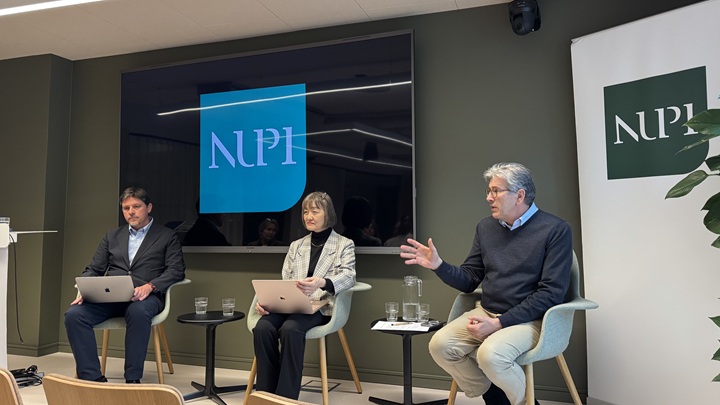
(From left) Rui Saraiva, Specially Appointed Professor at Miyazaki International University; Muto Ako, Specially Appointed Research Fellow at the JICA Ogata Research Institute; and Cedric de Coning, Research Professor at NUPI
At the opening of the seminar, Kari Osland, Director of NUPI and a contributing author to the volume, delivered the opening remarks. She emphasized the value of the book, explaining that it does not treat violent extremism as an isolated or independent threat, but instead examines how societies function and adapt under stress and what factors shape societal resilience. She also highlighted that the volume shows how resilience, peacebuilding, and the prevention of violent extremism—often discussed separately—are in fact closely interconnected.
This was followed by a session facilitated by de Coning, in which Muto provided an overview of the book and Saraiva outlined its key arguments. Rita Augestad Knudsen, Senior Research Fellow at NUPI and the Managing Director of the Consortium for Research on Terrorism and International Crime, and Andrew E. Yaw Tchie, Senior Research Fellow, who coordinates the Training for Peace Project at NUPI, offered comments, and a wide range of questions were raised by participants.
The discussion covered a broad array of issues, with the following key points emerging:
1. As suggested in the book, effective responses to preventing and countering violent extremism across diverse contexts go beyond containment measures such as security responses and military interventions. Instead, they are rooted in local communities, build on local agency and knowledge, and take a broader perspective that encompasses peacebuilding, social cohesion, and community resilience.
2. The book also highlights that many individuals join armed groups not primarily for ideological reasons but for survival, and that overemphasizing ideology risks overlooking more fundamental structural drivers.
3. While the need for comprehensive approaches is widely recognized, in practice security-first approaches that focus narrowly on adversaries are often adopted, and these frequently fail to address root causes.
4. Even in comprehensive, resilience-based approaches that include sectors such as health and education, it is important to consider how to avoid framing these areas primarily as tools for countering violent extremism (a process often referred to as “securitization”).
5. Although prevention is inherently difficult to measure because it concerns conflicts that did not occur, it may be possible—drawing examples from disaster risk reduction—to build a rationale for shifting resources from response to prevention.
6. While technologies, including AI, facilitate access to information, they also pose risks such as a tendency to favor more easily accessible or simplified areas of knowledge, and an overrepresentation of English-language sources, alongside the proliferation of misinformation. Strengthening the capacities and amplifying the voices of local researchers and practitioners is therefore essential for understanding local contexts.
The discussions were grounded in a shared understanding that there is no single “silver bullet” for preventing and countering violent extremism, and that what is required instead are sustained interventions at an appropriate scale, combined with an adaptive approach that learns from realities on the ground.
A NUPI podcast featuring Muto, de Coning, and Saraiva introducing the book has also been released:
An interview video with the authors is also available here:
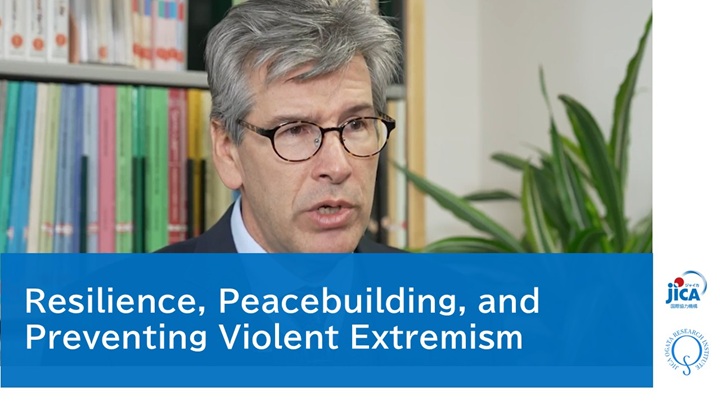
Interview | “Resilience, Peacebuilding, and Preventing Violent Extremism” with the Authors
A seminar on the publication of the book hosted by the Permanent Missions of Japan and Norway to the United Nations can be viewed at the following link:
Sns share!



事業事前評価表(地球規模課題対応国際科学技術協力(SATREPS)).国際協力機構 地球環境部 . 防災第一チーム. 1.案件名.国 名: フィリピン共和国.
事業事前評価表(地球規模課題対応国際科学技術協力(SATREPS)).国際協力機構 地球環境部 . 防災第一チーム. 1.案件名.国 名: フィリピン共和国.
事業事前評価表(地球規模課題対応国際科学技術協力(SATREPS)).国際協力機構 地球環境部 . 防災第一チーム. 1.案件名.国 名: フィリピン共和国.
事業事前評価表(地球規模課題対応国際科学技術協力(SATREPS)).国際協力機構 地球環境部 . 防災第一チーム. 1.案件名.国 名: フィリピン共和国.
事業事前評価表(地球規模課題対応国際科学技術協力(SATREPS)).国際協力機構 地球環境部 . 防災第一チーム. 1.案件名.国 名: フィリピン共和国.


