

Findings on Japanese Migration to South America Presented at the Latin American Studies Association Congress and the Japan Society for Migration Studies Annual Conference
2026.09.04







Updates from JICA Ogata Research Institute on the latest events, publications and more.
RegistrationHow to Find Us


Tanaka Roberto Shuichi, Research Fellow at the JICA Ogata Sadako Research Institute for Peace and Development (JICA Ogata Research Institute), presented findings of the project “A Study on Postwar Industrial Migration from Japan to Brazil,” at the Latin American Studies Association (LASA) Congress and the Japan Society for Migration Studies Annual Conference.
At the LASA Congress held in Paris, France, on May 29, 2026, Tanaka delivered his presentation titled “Migration as International Cooperation? Rhetoric in Japan's Emigration Policy and the Migrants' Reactions.” He examined how migrants themselves perceived the Japanese government's postwar narrative that emigration was a form of international cooperation, a concept promoted from the 1960s onward.
Focusing first on agricultural migrants who settled in countries such as Paraguay and Bolivia, Tanaka showed that while many initially aspired to contribute to local development, hardships stemming from poor settlement-site selection and inadequate support systems fostered distrust and resentment toward the Japanese government. Although agricultural production in these settlements eventually became successful and contributed to local economic development, these achievements were less the result of an explicit commitment to international cooperation than of migrants’ efforts to survive and achieve self-reliance.
The study also drew on interviews with industrial migrants who moved to Brazil. These interviews revealed that their decisions to migrate were largely motivated by personal factors, including the influence of acquaintances, frustration with limited career prospects in Japan, a desire to experience life abroad, and a spirit of adventure. Few regarded themselves as agents of international cooperation.
By comparing agricultural and industrial migrants, Tanaka demonstrated that a significant gap existed between the government's portrayal of migration as international cooperation and migrants’ actual motivations for emigrating. At the same time, migrants’ efforts to pursue their own goals and build livelihoods ultimately supported the development of local agriculture and industry in their host societies. The research offers a new perspective on how human mobility can contribute to local development.
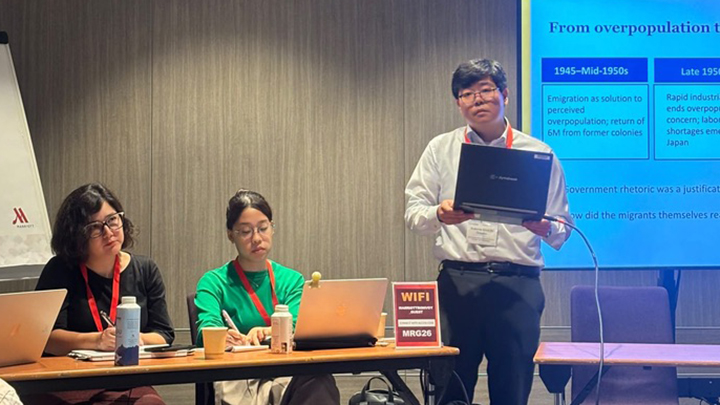
Tanaka Roberto Shuichi (far right), Research Fellow at the JICA Ogata Research Institute, presenting at the Latin American Studies Association Congress
At the 36th Annual Conference of the Japan Society for Migration Studies, held at Ritsumeikan University on July 4–5, 2026, Tanaka delivered a presentation titled “Testing One’s Skills on the Other Side of the Globe: Life Stories of Japanese Engineers Who Migrated to Brazil.” The presentation shared findings from an analysis of semi-structured interviews with 24 Japanese engineers who migrated to Brazil under the Industrial Migration Program introduced in 1961.
The study explored why many young Japanese engineers chose to migrate to Brazil despite strong demand for technical workers in Japan during the period of rapid economic growth. The findings identified a range of factors behind their decisions, including exposure to success stories from friends, family members, and teachers; perceived limitations on their career prospects in Japan due to credentialism; a strong desire to see the world; and, in some cases, a desire to leave their hometowns or concerns about economic uncertainty, such as the oil crisis.
A common characteristic among these industrial migrants was their curiosity and willingness to take on new challenges. Most had not originally set their sights specifically on Brazil. Rather, migration was driven by a broader desire to test their abilities and explore opportunities overseas. The study also found cases in which encouragement from wives played a decisive role in the migration decision. Tanaka argued that the Industrial Migration Program reflected the social, economic, and cultural conditions facing Japanese youth at the time. At the same time, he noted a limitation of the study: the individuals interviewed generally belonged to a group of industrial migrants who had achieved relatively successful settlement and career development in Brazil. To gain a fuller understanding of the overall experience of industrial migrants, future research will require a larger and more diverse sample.
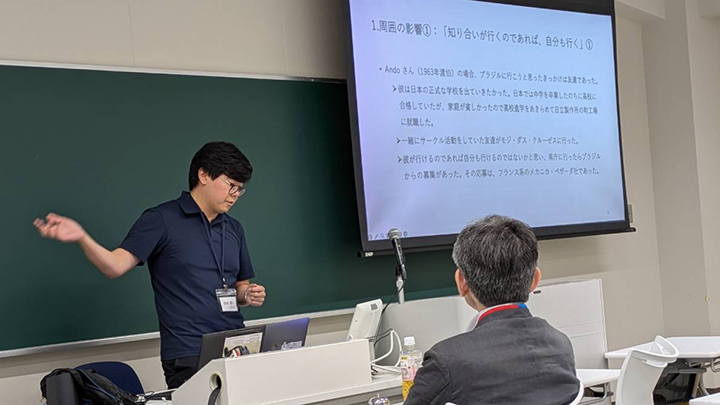
Tanaka Roberto Shuichi, Research Fellow at the JICA Ogata Research Institute, presenting at the 36th Annual Conference of the Japan Society for Migration Studies
To learn more about JICA’s overseas migration programs, please click the link below.
Sns share!



事業事前評価表(地球規模課題対応国際科学技術協力(SATREPS)).国際協力機構 地球環境部 . 防災第一チーム. 1.案件名.国 名: フィリピン共和国.
事業事前評価表(地球規模課題対応国際科学技術協力(SATREPS)).国際協力機構 地球環境部 . 防災第一チーム. 1.案件名.国 名: フィリピン共和国.
事業事前評価表(地球規模課題対応国際科学技術協力(SATREPS)).国際協力機構 地球環境部 . 防災第一チーム. 1.案件名.国 名: フィリピン共和国.
事業事前評価表(地球規模課題対応国際科学技術協力(SATREPS)).国際協力機構 地球環境部 . 防災第一チーム. 1.案件名.国 名: フィリピン共和国.
事業事前評価表(地球規模課題対応国際科学技術協力(SATREPS)).国際協力機構 地球環境部 . 防災第一チーム. 1.案件名.国 名: フィリピン共和国.


