

scroll


Since arriving at Nagoya University in September 2025, Ms. Shaufa Ahmed from the Republic of Maldives has been pursuing her studies as a JICA long-term participant in the Creating Leaders for Clean Cities course. We interviewed her about her academic journey and her experiences living and studying in Japan.
Please introduce yourself.
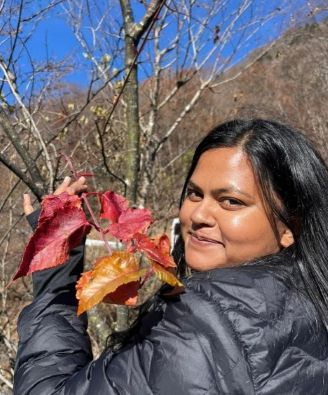
My name is Shaufa Ahmed, and I am from the Maldives. I am currently pursuing my Master’s degree in Civil and Environmental Engineering at Nagoya University under the JICA “Creating Leaders for Clean Cities” program. Before coming to Japan, I worked in the environmental sector, especially solid waste management, at the Government of the Maldives, where my experience inspired me to further develop my knowledge and contribute to more sustainable and resilient island communities.
What motivated you to apply for this JICA “CREATING LEADERS FOR CLEAN CITIES” program in Japan?
Working in the environmental sector in the Maldives allowed me to see firsthand the challenges small island communities face in managing waste and limited resources. The Maldives depends heavily on imported materials, while land for waste management is extremely limited. I applied for this program because I wanted to gain practical and academic knowledge in waste management, circular economy, and sustainable urban development, and Japan provides many valuable examples of how these challenges can be addressed.
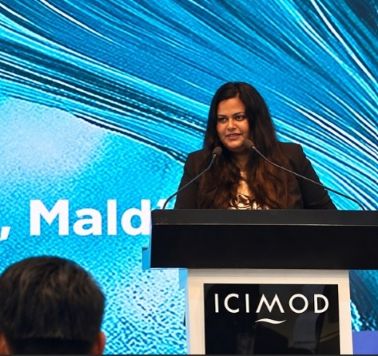
At a regional workshop on biodiversity data management and environmental reporting(Nepal)
What new knowledge, skills, or perspectives have you gained through your studies so far?
My studies in Japan have broadened my understanding of environmental challenges beyond simply managing waste after it is generated. I have learned to look at cities as systems, considering how materials and resources enter, are consumed, and eventually leave the system. Through concepts such as Material Flow Analysis, industrial ecology, and circular economy, I have gained new ways of identifying opportunities to reduce waste and keep resources circulating for longer.
I have also learned from Japanese examples of resource efficiency, recycling systems, and Eco-Towns. These experiences have helped me understand that technology alone is not enough; effective environmental management also requires good policies, institutions, community participation, and cooperation between different sectors.
How do you plan to apply what you have learned when you return to your country?
When I return to the Maldives, I hope to apply these approaches to the unique challenges faced by small island communities. My current research focuses on Villimalé, where I am studying material and resource flows and exploring opportunities to create a more circular island system.
In the longer term, I hope to contribute to policies and projects that improve resource efficiency, reduce waste generation, promote recycling and resource recovery, and strengthen sustainable waste management in the Maldives. I would also like to share the knowledge and experiences I gain in Japan with my colleagues and other environmental professionals.
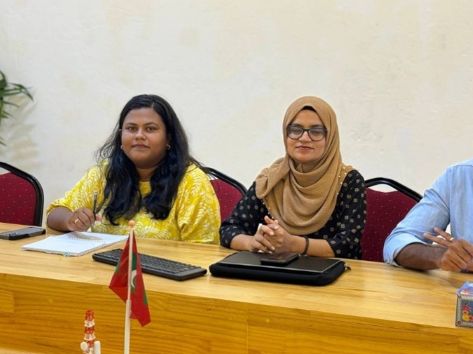
At a meeting for Nature Park Project, Maldives
What has your experience of living in Japan been like?
Before coming to Japan, one of my biggest concerns was adjusting to a new country where I did not speak the language, especially while balancing my studies and family life. However, I have been pleasantly surprised by how welcoming and helpful people have been. At Nagoya University, I have also had the opportunity to meet students from Japan and many other countries, exchange ideas and experiences, and build friendships beyond the classroom.
Outside my studies, I enjoy exploring Japan with my family. During weekends and holidays, we often take trips to experience Japan’s beautiful natural landscapes and different seasons. Some of my favorite memories have been visiting places such as Okinawa, the Mt. Fuji area, and Shirakawa-go. These experiences have allowed me to learn about Japan beyond university life and have created wonderful memories for my family.
What has surprised me most is how safe, organized, and convenient everyday life can be, from public transportation to the cleanliness of public spaces. At the same time, living here has taught me to adapt to cultural and language differences and become more confident in unfamiliar situations. Overall, my experience in Japan has been much more than an academic journey; it has also been an important period of personal growth and cultural exchange.
What message would you like to share with waste management professionals who are considering studying in Japan?
I would strongly encourage waste management professionals to consider studying in Japan. Japan offers an opportunity not only to learn advanced technologies and waste management practices, but also to see how environmental responsibility can be incorporated into policies, industries, communities, and everyday life.
My advice would be to come with an open mind, ask questions, visit facilities and communities whenever possible, and learn from both the successes and challenges you observe. Most importantly, think about how the knowledge gained in Japan can be adapted to the realities of your own country rather than simply replicated.
A Few Words from the Academic Supervisor
Professor Hiroki TANIKAWA,
Department of Environmental Engineering and Architecture, Graduate School of Environmental Studies, Nagoya University
Shaufa is the first student from the Maldives to join our laboratory. She has been conducting research with great dedication on circular economy and resource management, focusing specifically on island environments like the Maldives. Small island developing states face urgent challenges that require swift and decisive actions, simultaneously addressing both climate change impacts and sustainable material cycles. I sincerely hope that the knowledge and insights she has gained in Japan will contribute significantly to her home country, and I look forward to seeing her play a leading role in building a sustainable and resilient future for the Maldives.
A Message to Prospective Applicants: Learning at Nagoya University through the JICA Clean City Course
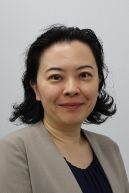
Professor Miho IRYO,
Department of Environmental Engineering and Architecture, Graduate School of Environmental Studies, Nagoya University
Graduate Schools of Environmental Studies and Engineering at Nagoya University offer Nagoya University Global Environmental Leaders Program (NUGELP), in which students from diverse countries, particularly across Asia, as well as many JICA trainees learn with Japanese students. Ms. Shaufa Ahmed actively contributes to discussions by sharing challenges facing her home country and organizing key points in group work. This program is ideal for those who wish to deepen their expertise and work with peers to address challenges through dialogue.