








Mainstreaming Disability Inclusion in JICA Projects
Guidance Note
Introduction
Are the awareness materials produced under your project truly accessible to everyone?
A video that lacks captions does not provide full accessibility for persons who are deaf or hard of hearing. Likewise, text that contains technical terms can be inaccessible to persons with intellectual or cognitive disabilities, particularly in the absence of plain language and visual supports.
To be clear, captions, plain language, pictograms, and illustration-based materials should not be considered “special” add-ons for “only persons with disabilities.” They are core elements of accessibility and universal design.
Illustration-supported text, for example, can facilitate understanding not only for persons with disabilities, but also for people with limited learning capacities, people acquiring the official language, older persons, and anyone accessing information under time pressure or stress. In addition, providing text-based descriptions of illustrations ensures that information is equally accessible to persons who are blind or visually impaired, as well as to those who rely primarily on text rather than visual materials. By combining visual aids with clear written explanations, we can create communication that is inclusive, user-friendly, and supportive of diverse information needs.
Incorporating a diverse disability perspective strengthens development cooperation by removing barriers, expanding equitable access, and improving the likelihood that assistance reaches those who would otherwise be excluded.
JICA aims for development cooperation that leaves no one behind and advances mainstreaming disability inclusion across all projects.
* This document is provided in PDF format. From an accessibility perspective, if you would like to receive it in a text format (e.g., MS Word), please contact us at the address below.
Human Development Department Higher Education and Social Security Group
Social Security Team hmghs@jica.go.jp
Purpose and Structure
This Guidance Note outlines the fundamental principles and operational approaches for promoting the mainstreaming of disability inclusion in JICA projects and serves as a useful resource for all stakeholders involved in international cooperation.
The Guidance Note comprises two parts: the Guidance Note: Core Principles and Guidance for All Thematic Areas and the Sector-Specific Guidance Notes.
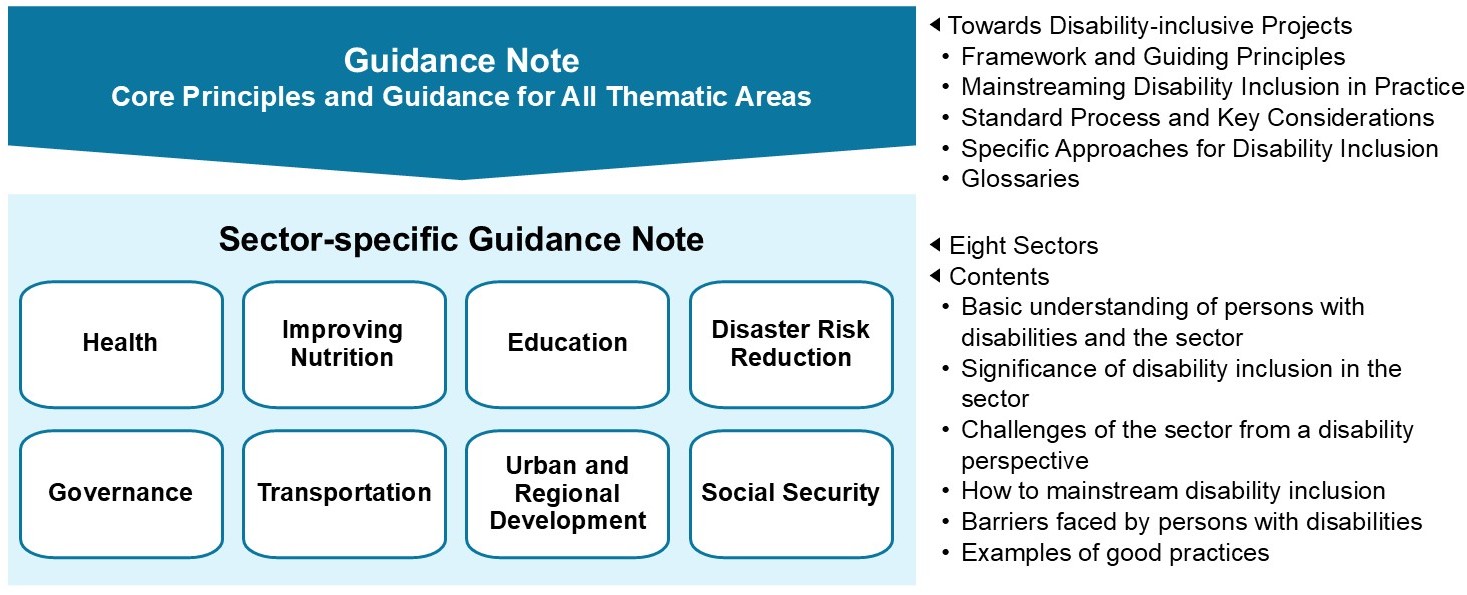
Mainstreaming Disability Inclusion in JICA Projects Guidance Note
Core Principles and Guidance for All Thematic Areas
Sector-Specific Guidance Not
This Guidance Note was prepared as an outcome of JICA’s project, “Project for Developing Sector-Specific Guidance Notes for Mainstreaming Disability Inclusion in JICA Operations” (January 2025–February 2026).