

Expo 2025 Theme Week Event “Shaping the Future with JICA: The SDGs, Dynamic Realities of Developing Countries, and Our Path Forward”
2025.12.26





Updates from JICA Ogata Research Institute on the latest events, publications and more.
RegistrationHow to Find Us


On Oct. 5, 2025, the JICA Ogata Sadako Research Institute for Peace and Development (JICA Ogata Research Institute) held an event titled “Shaping the Future with JICA: The SDGs, Dynamic Realities of Developing Countries, and Our Path Forward” to celebrate the SDGs+Beyond Future Society for Life Week during Expo 2025 Osaka, Kansai, Japan (Expo 2025).
With Sato Ichiro, Executive Senior Research Fellow, JICA Ogata Research Institute, as the host, the event started with the keynote lecture “The Significance, Challenges and Future Prospects of the SDGs, and Beyond 2030: Toward a Future Society for Life” by Kanie Norichika, Professor, Graduate School of Media and Governance, Keio University. Kanie explained that the Sustainable Development Goals (SDGs) aim for sustainable growth from three perspectives: economy (money), environment (Earth) and society (people). Noting that while only about 35% of the SDG targets are expected to be achieved by the 2030 deadline, he said that the financing gap of 3.9 trillion USD for SDG achievement can be viewed as a huge business opportunity. Kanie then introduced the “transformation S-curve,” which was originally presented in the Global Sustainable Development Report 2023 (GSDR 2023). He explained that although innovation is slow at first, when leverage conditions such as the economy, financial resources, governance and technology are combined at a tipping point, transformation is accelerated. He noted that actions taken by people and businesses are already starting to change. Sharing examples like the Public Private Forum on Beyond SDGs, launched to set out a post-2030 vision, Kanie emphasized that initiatives rooted in each local area and its cultures are essential in order to achieve the SDGs. He concluded by saying that although the path is narrow there is hope.
Professor Kanie Norichika, Keio University, gives a keynote lecture.
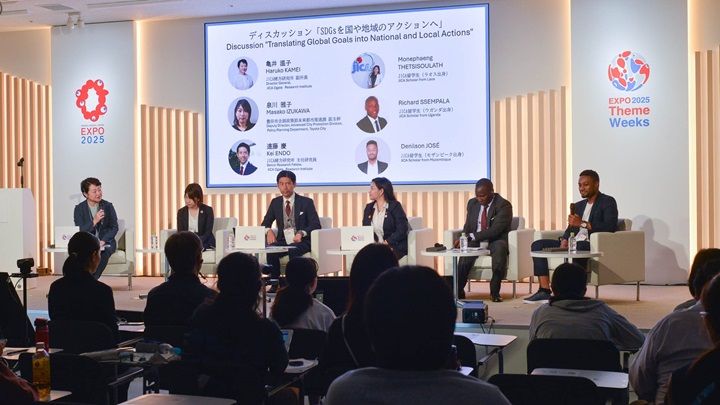
Kamei Haruko, Director General, JICA Ogata Research Institute, was the moderator of the discussion session “Translating Global Goals into National and Local Actions.”
The session started with a presentation by Endo Kei, Senior Research Fellow, JICA Ogata Research Institute, on SDG initiatives in Japan, which are becoming increasingly localized. In Japan, as of 2025, 216 local governments have formulated SDGs Future City Initiatives, which are unique to Japan, and are working on efforts that link the SDGs and regional revitalization. Such, according to Endo, are the features of Japanese SDG initiatives. He analyzed that the following are effective as the awareness rate of SDGs in Japan is high at 91.6% (as of 2023): localization through the collective efforts of the national government, local governments, companies, the media, educational institutions and citizens, in terms of raising awareness; and having each local government set its own priority goals to develop relevant projects and their indicators, in terms of implementation. Endo identified the challenges, including the excess concentration of priority goals of local governments to certain SDGs and the need to develop methods to monitor progress toward SDG achievement. He then introduced a research project by the JICA Ogata Research Institute that proposes a novel indicator framework for the SDGs.
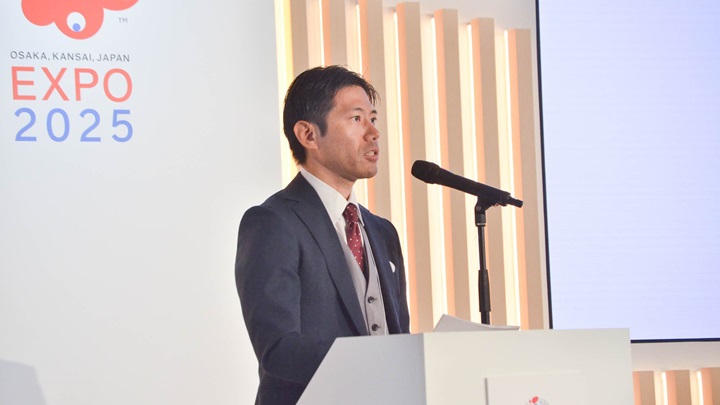
Endo Kei, Senior Research Fellow, JICA Ogata Research Institute, gives a presentation about efforts in Japan to reach the SDGs.
The next presentation was by Izukawa Masako, Deputy Director, Advanced City Promotion Division, Toyota City, on leading-edge efforts to achieve the SDGs by the city. Toyota, located in Aichi Prefecture, is known for its huge automotive industry. Izukawa shared that the city continues its efforts after being selected as an SDGs Future City. Shared examples included the following: unique initiatives like the Toyota SDGs Partners, a registration scheme with around 300 entities registered, and the SDGs Certification System, which evaluates initiatives by businesses; and a mechanism to secure the involvement of a wide range of stakeholders through public-private partnerships. Izukawa also shared that the city has jointly developed the SDG Achievement Evaluation Indicators for Prefectures and Municipalities in Japan, with the United Nations Centre for Regional Development (UNCRD) and published the “Voluntary Local Review (VLR)” as part of its efforts to evaluate its SDG achievement status. She then added that staff members of each department consciously incorporate the SDGs into city policies. Izukawa stated that Toyota City will continue to take on the challenge of achieving the SDGs with a strong sense of mission that local governments can take the lead and change the world through bottom-up approaches.
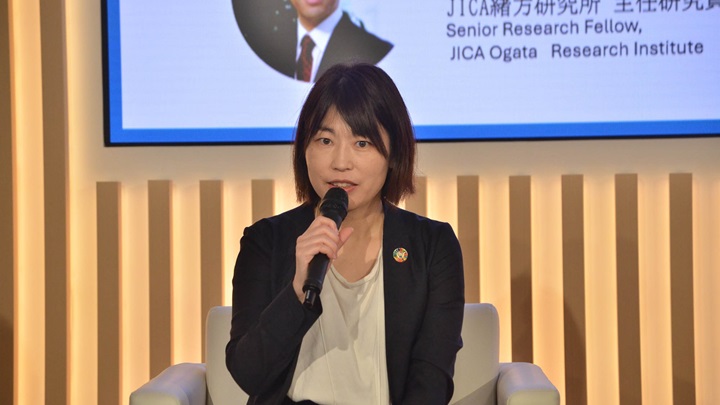
Izukawa Masako, Deputy Director, Advanced City Promotion Division, talks about the initiatives of Toyota City.
Three JICA Scholars then reported on the current status of SDG achievement in their home countries. A panel discussion followed.
Monephaeng Thetsisoulath of the Ministry of Finance of Lao PDR studies at Doshisha University. She explained that although the SDGs are incorporated into national development plans of Lao PDR, efforts at the local government level remain limited. Thetsisoulath then asked for advice on how such efforts could be strengthened and moved forward. Endo responded by explaining that in Japan, the central government first provided guidance and then developed the framework for the SDGs Future City Initiative, which helped the SDGs become widely known. He also added that the network of local governments is important as well, in order to enable front-running local governments to share knowledge and human resources with other local governments. Thetsisoulath reflected that this offers an important insight for Lao PDR, where strengthened local capacity and collaboration could help accelerate SDG localization.
Richard Ssempala is an economist from Uganda, currently studying at Osaka Metropolitan University. Drawing on Uganda’s experience in raising awareness for public initiatives such as COVID-19 vaccination through the use of music, dance and drama especially among the youth, he underscored the importance of such creative approaches in raising awareness about the SDGs. Ssempala therefore proposed that it may be possible to effectively raise awareness of the SDGs by using music and games in Japan as well. Izukawa took Toyota SDGs Master, a card game made by Toyota City, as an example of a means that allows children to learn about the SDGs at school while having fun, and agreed with the effectiveness of means that feature unique local aspects.
Denilson José is from Mozambique and currently studies at Doshisha University. Based on his experience both as an entrepreneur and working on the SDGs at AIESEC—a global non-profit organization run by students—he shared that Mozambique’s focus is on leveraging public-private partnerships and innovation and asked why public-private partnerships are successful in Japan. Izukawa answered that in Toyota, the SDGs serve as a common language for different stakeholders in public and private sectors. She added that when local governments make their strengths and weaknesses public, businesses become aware of existing issues and perceive unaddressed issues as business opportunities. This sometimes leads to new ideas.
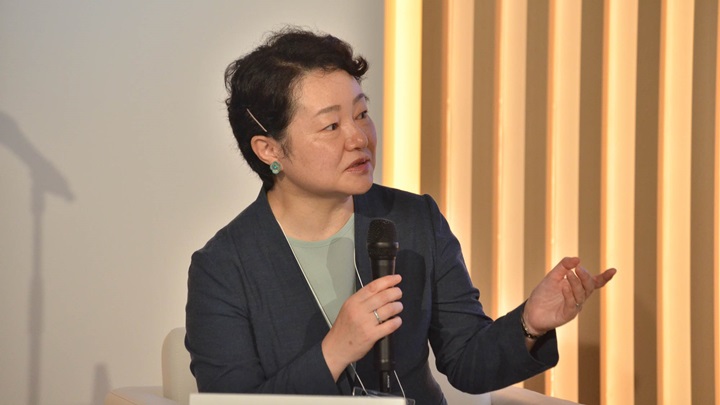
Kamei Haruko, Director General, JICA Ogata Research Institute, the moderator
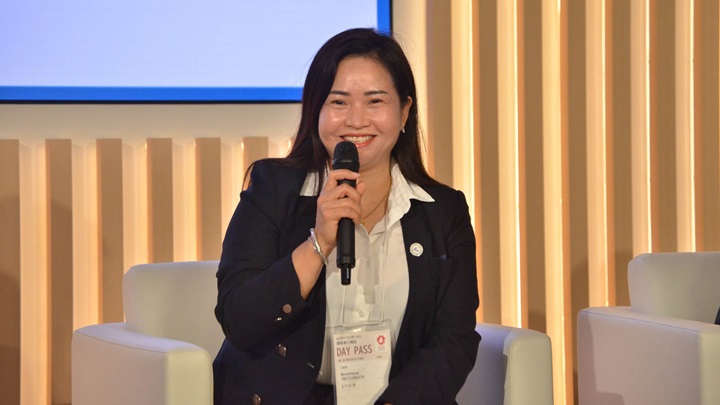
Monephaeng Thetsisoulath, JICA Scholar from Lao PDR

Richard Ssempala, JICA Scholar from Uganda

Denilson José, JICA Scholar from Mozambique
Kanie wrapped up the discussion, commenting that all countries are developing countries when viewed from the perspective of sustainable development and by learning from each other through continued networking, we can overcome division and our efforts will become powerful.
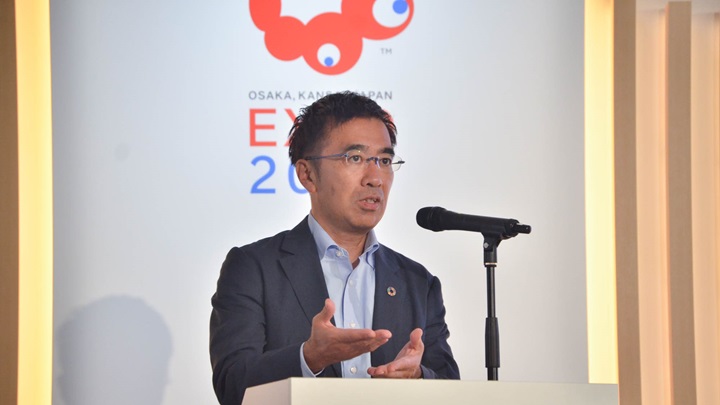
Mine Yoichi, Executive Director, JICA Ogata Research Institute, gave closing remarks. He pointed out that because the issues are in fact right in front of us, they should not be compared by country but rather should be visualized at the local level and be addressed with bottom-up approaches. Mine emphasized the importance of efforts that link community development in Japan and problem solving in developing countries, introducing data for SDG indicators set by Japanese local governments such as the SDGs Miyagi Model and the SDGs Aichi Model, which are shown in books like “SDGs and Japan: Human Security Indicators for Leaving No One Behind” and “SDGs and Local Communities: How to Create Human Security Indicators in Your Town!” He then shared that the JICA Ogata Research Institute is currently developing new indicators to visualize the challenges around human security and SDGs that developing countries around the world are facing. Mine closed the event by expressing his hope to make today’s event a steppingstone to make the world a place where the dignity and rights of each and every person are secured.
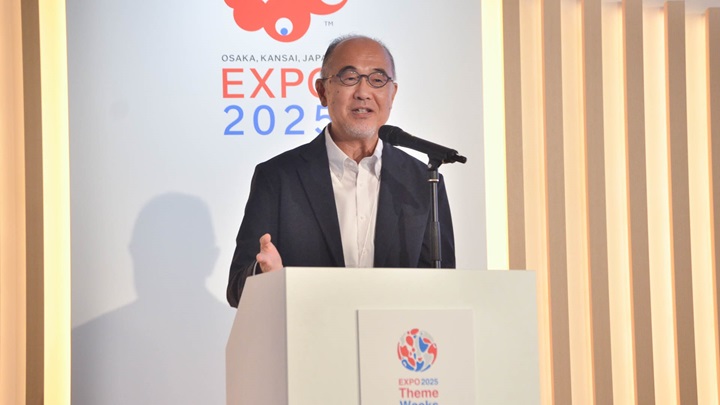
Mine Yoichi, Executive Director, JICA Ogata Research Institute, gives closing remarks.
A video recording of this event can be viewed at the link below. The video audio is in Japanese, but you can change the subtitles from Japanese (auto-generated) to English in the YouTube settings.
Sns share!



事業事前評価表(地球規模課題対応国際科学技術協力(SATREPS)).国際協力機構 地球環境部 . 防災第一チーム. 1.案件名.国 名: フィリピン共和国.
事業事前評価表(地球規模課題対応国際科学技術協力(SATREPS)).国際協力機構 地球環境部 . 防災第一チーム. 1.案件名.国 名: フィリピン共和国.
事業事前評価表(地球規模課題対応国際科学技術協力(SATREPS)).国際協力機構 地球環境部 . 防災第一チーム. 1.案件名.国 名: フィリピン共和国.
事業事前評価表(地球規模課題対応国際科学技術協力(SATREPS)).国際協力機構 地球環境部 . 防災第一チーム. 1.案件名.国 名: フィリピン共和国.
事業事前評価表(地球規模課題対応国際科学技術協力(SATREPS)).国際協力機構 地球環境部 . 防災第一チーム. 1.案件名.国 名: フィリピン共和国.


