

Research Findings Shared at the 36th JASID Conference
2026.03.27







Updates from JICA Ogata Research Institute on the latest events, publications and more.
RegistrationHow to Find Us


The 36th Annual Conference of the Japan Society for International Development (JASID) , themed “Opening Prospects for Peace and Development: A Dialogue Toward the Future,” was held at Hiroshima University on Nov. 29–30, 2025. Researchers from the JICA Ogata Sadako Research Institute for Peace and Development (JICA Ogata Research Institute) delivered the following presentations.
Senior Research Advisor Kayashima Nobuko and Professor Umemiya Naoki of Sophia University reported on the follow-up study conducted under the JICA Ogata Research Institute’s research project, “Empirical Research on Impacts of Study Abroad in Developing Countries – based on the Study Abroad Experiences of Academic Professionals of Major Universities in ASEAN Countries .”
This study analyzed interview data collected from eight Indonesian university faculty members who earned their doctoral degrees in Japan in the field of resource engineering, as well as from the five Japanese university faculty members who supervised them during their studies. Using the framework of social exchange theory, the study examined how diverse forms of academic collaboration emerged from the initial doctoral study abroad experience. The researchers found that equitable and reciprocal relationships helped build trust, fostering further collaboration, while institutional and financial support also served as important enabling factors. Commentators and participants raised questions regarding comparisons with other fields and countries as well as the interplay among various enabling factors, leading to a lively and engaging discussion.
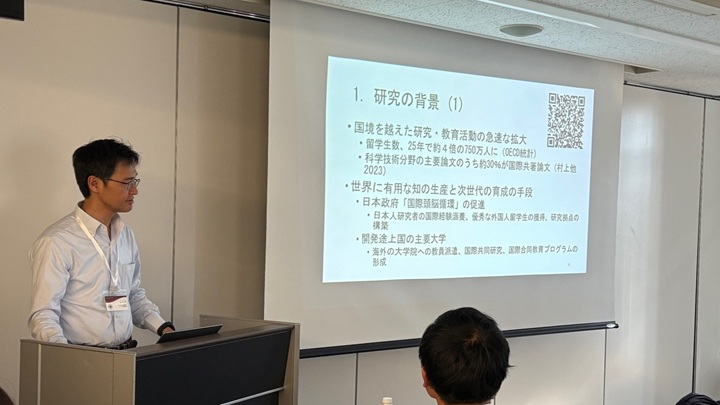
Professor Umemiya Naoki of Sophia University
As part of the research project titled “An empirical research on the impact of the SHEP approach on small-scale farmers ,” Asmiro Abeje Fikadu and Nomura Hisako, from the Department of Agricultural and Resource Economics, Faculty of Agriculture, Kyushu University, Japan, presented their empirical findings on how climate-smart horticulture (CSH) practices affect horticultural yields under the Smallholder Horticulture Empowerment and Promotion (SHEP) approach in Ethiopia. Co-researchers included Girma G. Gebre of the Leibniz-Centre for Agricultural Landscape Research (ZALF), Germany, and Payal Shah of the Okinawa Institute of Science and Technology Graduate University (OIST), Japan.
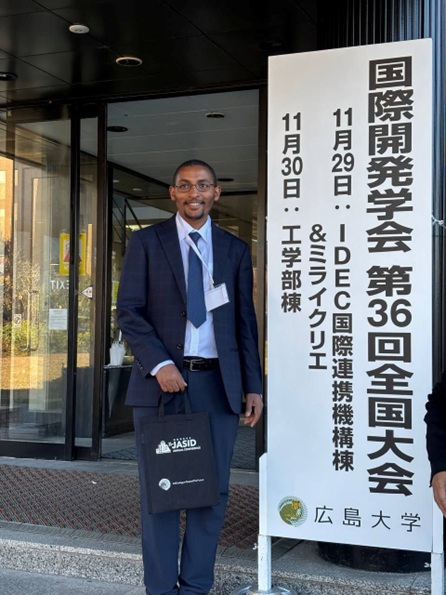
Asmiro Abeje Fikadu from the Department of Agricultural and Resource Economics, Faculty of Agriculture, Kyushu University, Japan
Using quantile regression models complemented by inverse probability weighting, the study identified the distributional impacts of CSH adoption and the SHEP approach on horticultural crop yield. The study particularly found that even when farmers receive the same SHEP training, their production levels (yields) can vary significantly.
Discussants and participants alike emphasized the importance of aligning CSH practices to enhance horticultural productivity. They also underscored the policy implications for farmers with particularly low yields, given that SHEP impacts vary across farmer. Furthermore, the discussion highlighted the need to integrate region-specific qualitative knowledge more deeply with quantitative analysis.
Overall, the session offered valuable feedback that will guide future revisions, strengthen policy relevance, and sharpen the study’s contribution to climate-resilient agricultural development.
This roundtable was organized to explore, from multiple perspectives, how donor countries and aid agencies influence the formulation of education policies and practices in partner countries. The discussion was set against the backdrop of increasingly visible competition among donors over the knowledge claims that determine the definition of “quality education” under Sustainable Development Goal (SDG) 4 and the policies and practices deemed effective for its attainment.
Research Fellow Ikeda Ami delivered a presentation titled, “Changes in Partner Countries Triggered by International Education Cooperation Projects: A Case Study of the Technical Cooperation Project for Strengthening Mathematics and Science in Secondary Education (SMASSE) in Kenya.” She highlighted that although international cooperation often constitutes a temporary intervention from the partner country’s perspective, the SMASSE Project continues to have an impact more than ten years after its completion. Kenya remains actively engaged in revising and developing in-service training for mathematics and science teachers in alignment with its own policies and institutional frameworks. Other speakers presented analyses on donor engagement in the education sector and on cooperation approaches by China and Japan. The subsequent discussion also addressed issues such as the feedback loop between international education cooperation and Japanese society.
Roundtable | Human Mobility in Development Cooperation from a Human Security Perspective: Proposing an Aspiration–Capability Expansion Model
This roundtable was convened by Saito Kiyoko , then-Senior Research Fellow, and lead researcher of the ongoing study “International Migration Routes and Route Selection Mechanisms ”, and Orita Tomomi , Principal Research Fellow, together with Deputy Director Lee Chiaki of JICA’s Governance and Peacebuilding Department. Serving as discussants were Visiting Fellow Sato Hiroshi and Murotani Ryutaro, Senior Deputy Director General at JICA’s Operations Strategy Department. The session examined how de Haas’s aspiration–capability theory can be reconstructed from a human security perspective and discussed the methodological approaches required to ensure “appropriate interventions for the right people at the right time” depending on different mobility patterns.
The discussion further explored what constitutes threats, and how protection and empowerment should be conceptualized, when human security is applied to the context of human mobility. Participants emphasized the importance of ensuring that development cooperation also reaches migrants who may be potentially vulnerable.
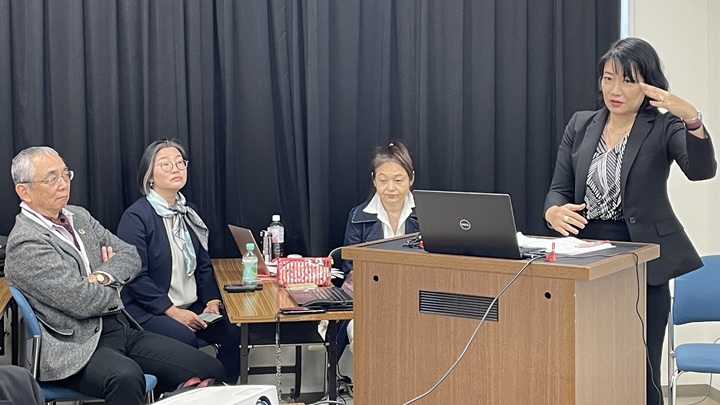
(From left) Visiting Fellow Sato Hiroshi, Deputy Director Lee Chiaki, then-Senior Research Fellow Saito Kiyoko, and Principal Research Fellow Orita Tomomi
In today’s increasingly uncertain world, the emergence and spread of violent extremism remain a major obstacle to progress in peace and development. Against this backdrop, the roundtable introduced the open-access book “Resilience, Peacebuilding, and Preventing Violent Extremism: A Complex Systems Perspective on Sustaining Peace ,” which represents the outcome of a research project of the same title conducted by the JICA Ogata Research Institute. Three contributors to the book—Rui Saraiva (Miyazaki International University), Muto Ako (Specially Appointed Research Fellow, JICA Ogata Research Institute), and Udeni Appuhamilage (Tokyo University of Foreign Studies)—presented case studies from Mozambique, Syria, and Sri Lanka, illustrating the complex dynamics of violent extremism and ways to preventing and countering it through resilience and adaptive peacebuilding approaches.
Building on these examples, the discussion turned to the book’s broader argument, which emphasizes social cohesion, resilience, and adaptive peacebuilding over conventional security-led approaches. Commentators Maryam AlKubati (Research Fellow, JICA Ogata Research Institute), Orita Tomomi , and Murotani Ryutaro offered critical insights, while questions from the floor sparked lively debate. Participants explored what roles external actors can play in strengthening the capacity of communities and how community-level resilience connects to state resilience. The exchange highlighted how complex social systems respond to stresses caused by violent extremism and how peacebuilders can support societies in volatile contexts by enhancing community resilience and the adaptive capacity to sustain peace.
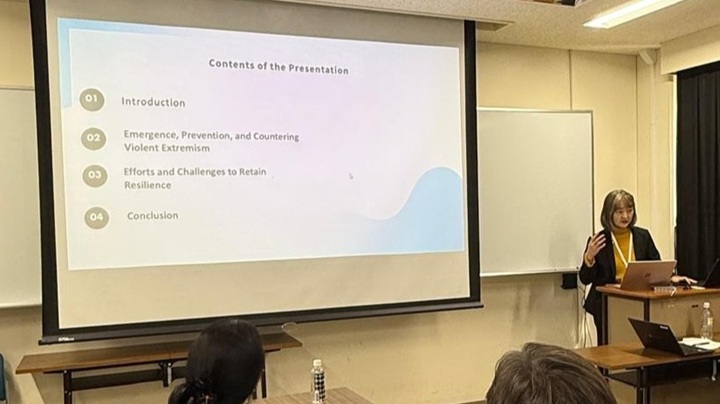
Specially Appointed Research Fellow Muto Ako
This session was organized in response to a set of questions raised by Professor Soyeon Kim of Sogang University (Republic of Korea) and others, who argue that under compounded crises and pervasive uncertainty, international development cooperation should be redefined not merely as support for developing countries, but as a more multi-directional and mutually beneficial approach—one that seeks to link and address sustainability challenges within donor countries and global issues in an integrated manner.
Chaired by Sato Hiroshi, the session featured a presentation by Orita Tomomi, who shared insights from the JICA research project, “Leveraging International Cooperation for Local Strengthening: A Study on the Contribution of JICA’s Domestic Citizen-Engagement Programs to Regional Internationalization and Revitalization.” Her presentation demonstrated how JICA’s domestic programs have facilitated the internationalization and revitalization of local communities in Japan, thereby functioning as a mechanism through which the outcomes of international cooperation circulate back into Japanese society. She also offered a perspective supporting the question posed by other researchers—namely, that the true value of Japan’s ODA may lie in its ability to design and generate meaningful domestic–international linkages.
Sns share!



事業事前評価表(地球規模課題対応国際科学技術協力(SATREPS)).国際協力機構 地球環境部 . 防災第一チーム. 1.案件名.国 名: フィリピン共和国.
事業事前評価表(地球規模課題対応国際科学技術協力(SATREPS)).国際協力機構 地球環境部 . 防災第一チーム. 1.案件名.国 名: フィリピン共和国.
事業事前評価表(地球規模課題対応国際科学技術協力(SATREPS)).国際協力機構 地球環境部 . 防災第一チーム. 1.案件名.国 名: フィリピン共和国.
事業事前評価表(地球規模課題対応国際科学技術協力(SATREPS)).国際協力機構 地球環境部 . 防災第一チーム. 1.案件名.国 名: フィリピン共和国.
事業事前評価表(地球規模課題対応国際科学技術協力(SATREPS)).国際協力機構 地球環境部 . 防災第一チーム. 1.案件名.国 名: フィリピン共和国.


