

Innovation in Infrastructure Impact: A Discussion Among Researchers From the World Bank, ADB and the JICA Ogata Research Institute
2026.03.03







Updates from JICA Ogata Research Institute on the latest events, publications and more.
RegistrationHow to Find Us


LEADS (Learn, Adapt, and Scale) workshops , organized by the World Bank’s Development Impact Group, bring together researchers and practitioners from around the world to integrate evidence and data analysis into operations. Ahead of the Tokyo workshop, the World Bank, the Asian Development Bank (ADB), and the Japan International Cooperation Agency (JICA) jointly hosted a research conference, “Innovation in Infrastructure Impact ” on Jan. 26, 2026, at the World Bank Tokyo Development Learning Center.
Participants from the JICA Ogata Sadako Research Institute for Peace and Development (JICA Ogata Research Institute) were Visiting Fellow Teguh Dartanto , Research Fellow Solomon Haddis Teklehaymanot, Executive Senior Research Fellow Sato Ichiro , and Senior Research Fellow Yamada Eiji . The conference marked a significant milestone in bringing together international partners to explore the links between research and infrastructure delivery.
In the panel discussion, the panelists discussed how infrastructure investment decisions and their development impacts are shaped by political economy dynamics, governance and institutional alignment, and the need to integrate social infrastructure with physical infrastructure.
Dartanto emphasized the need to complement physical infrastructure with social infrastructure to translate access and connectivity into improved human capital, productivity, and welfare outcomes. Drawing on a JICA Ogata Research Institute project initiated in 2018, he described efforts to estimate social infrastructure needs—such as schools, hospitals, public housing, and public facilities—across ASEAN countries. He noted that the Institute’s analysis goes beyond estimating investment flows to consider gaps, replacement, rehabilitation, and operating and maintenance costs. Such costs are often more important than new construction but tend to attract lower political returns, even though physical infrastructure alone is insufficient to generate lasting welfare gains.
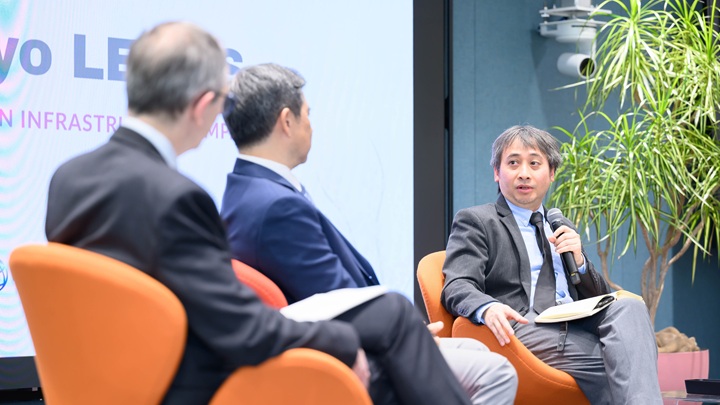
Teguh Dartanto, Visiting Fellow at the JICA Ogata Research Institute (Photo: The World Bank)
In the following session, “How Impact Evaluation Illuminates the Benefits of Infrastructure,” Teklehaymanot presented joint research examining how road connectivity is associated with rural economic outcomes in Tanzania, focusing on how results differ depending on which urban destinations households can reach. Using Tanzania’s trunk and regional road network data combined with urban agglomeration information and the Tanzania Living Standards Measurement Survey, the study examines how improved connectivity—measured by the road-based market access indicator to Dar es Salaam and an access indicator to secondary cities—is associated with rural labor allocation, agricultural production, and commercialization in Tanzania. The findings show that “destination matters.” Improved access to the primary city, Dar es Salaam, is associated with reduced agricultural labor, higher use of modern inputs, increased productivity, and greater commercialization, including shifts toward higher-value crops. In contrast, improved connectivity to secondary cities is associated with smaller gains in the service sector and weak or negative outcomes for agricultural production and commercialization. Teklehaymanot emphasized that these findings suggest that road investment alone may not be sufficient to fully utilize the potential of secondary cities and that complementary investments may be required to support rural development.
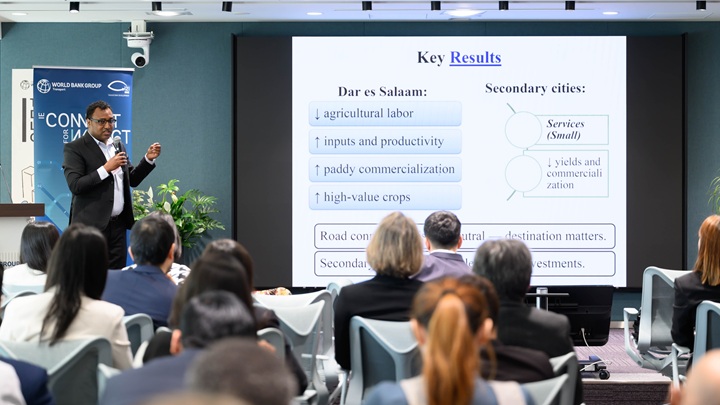
Solomon Haddis Teklehaymanot, Research Fellow at the JICA Ogata Research Institute, delivers a presentation. (Photo: The World Bank)
In the same session, “How Impact Evaluation Illuminates the Benefits of Infrastructure,” Sato explained that conventional infrastructure planning, which relies on predicting a single future and designing an optimal plan for that scenario, is risky under deep uncertainty, particularly for projects with long operational lives and high sensitivity to climate conditions. To address this, his team uses a Robust Decision Making (RDM) framework that starts by identifying available policy measures and then stress-tests them across many future scenarios to reveal vulnerabilities. Measures are iteratively improved until they are likely to perform robustly across a wide range of uncertain futures.
Sato illustrated this through a case study of urban flood mitigation in the Colombo Region of Sri Lanka, focusing on two river basins where wetland loss and the decline of paddy fields have increased flood risk. Using outcome simulations of measures proposed under a JICA-supported storm water drainage master plan, he showed that poorer households in temporary housing are more exposed to flooding, while mitigation measures reduce inundation and make outcomes more robust under uncertain future conditions associated with climate change. He concluded that systematic scenario analysis is essential for evaluating climate adaptation effectiveness and that RDM provides a practical framework for doing so.
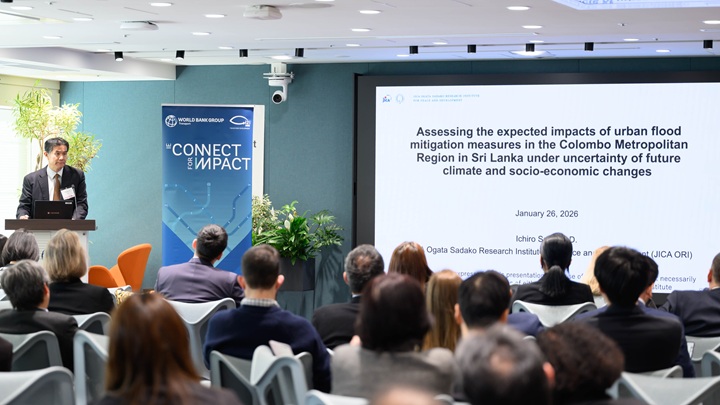
Sato Ichiro, Executive Senior Research Fellow at the JICA Ogata Research Institute, delivers a presentation. (Photo: The World Bank)
In the following session, “Assessing Heterogeneity in the Benefits of Infrastructure,” Yamada presented findings from a household panel survey examining the socio-economic impacts of Dhaka’s MRT Line 6, a major urban rail investment in an extremely dense, lower-middle-income city. Using a panel of approximately 4,000 households tracked from early 2023 to early 2025 and a continuous difference-in-differences approach based on distance to stations, he examined how MRT access affects travel behavior and economic outcomes.
He showed that MRT users travel longer distances at higher speeds and that, while total trip costs are higher than for buses, per-kilometer costs are lower for longer commutes. Among men, MRT use does not differ by education, employment, or income within the nearest two kilometers, but among women, there is a clear income gap, with low-income women seldom using the MRT. At the household level, proximity to MRT stations delivers significant income gains for the bottom 40 percent through increased employment of both males and females, while reducing the incidence of NEET (Not in Education, Employment, or Training) among youth.
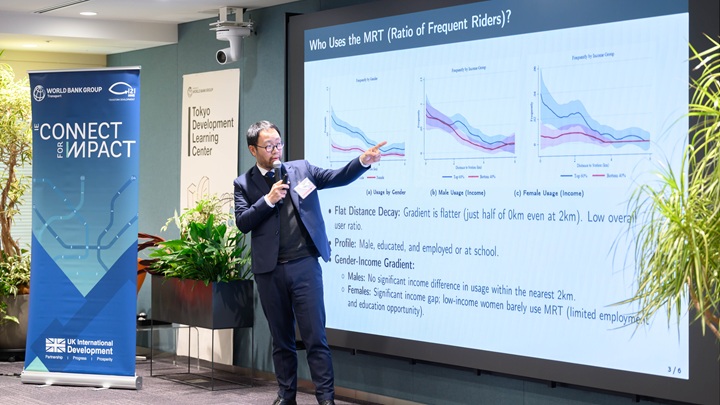
Yamada Eiji,Senior Research Fellow at the JICA Ogata Research Institute, delivers a presentation. (Photo: The World Bank)
In addition to this research conference, researchers from the JICA Ogata Research Institute also participated in the main LEADS workshop, helping to bridge evidence and operations by contributing to discussions and sharing insights from their research. For details of the workshop, please refer to the articles below (World Bank Group and JICA website).
For further information on the research presented in the article, please click the links below.
Sns share!



事業事前評価表(地球規模課題対応国際科学技術協力(SATREPS)).国際協力機構 地球環境部 . 防災第一チーム. 1.案件名.国 名: フィリピン共和国.
事業事前評価表(地球規模課題対応国際科学技術協力(SATREPS)).国際協力機構 地球環境部 . 防災第一チーム. 1.案件名.国 名: フィリピン共和国.
事業事前評価表(地球規模課題対応国際科学技術協力(SATREPS)).国際協力機構 地球環境部 . 防災第一チーム. 1.案件名.国 名: フィリピン共和国.
事業事前評価表(地球規模課題対応国際科学技術協力(SATREPS)).国際協力機構 地球環境部 . 防災第一チーム. 1.案件名.国 名: フィリピン共和国.
事業事前評価表(地球規模課題対応国際科学技術協力(SATREPS)).国際協力機構 地球環境部 . 防災第一チーム. 1.案件名.国 名: フィリピン共和国.


