

From Aid to Co-Creation: Senior Research Advisor Ohno Izumi Discusses Japan's Role in a Changing Development Landscape
2026.08.31





Updates from JICA Ogata Research Institute on the latest events, publications and more.
RegistrationHow to Find Us


Ohno Izumi , Senior Research Advisor at the JICA Ogata Sadako Research Institute for Peace and Development (JICA Ogata Research Institute) and Professor Emeritus at the National Graduate Institute for Policy Studies (GRIPS), participated in academic conferences and seminars in the Republic of Korea, where she discussed the importance of knowledge co-creation and the role of Japanese development cooperation in a changing global landscape.
On June 24, 2026, Ohno participated in the summer conference of the Korea Association of International Development and Cooperation (KAIDEC), held at Dongseo University in Busan, Republic of Korea, under the theme “Global Transformations and the Way Forward: Implementing Korea’s Fourth Basic Plan for International Development Cooperation.” She spoke at a session organized by the Korea Development Institute (KDI) titled “Mutual Gains in Development Cooperation and Strategic Economic Partnerships.”
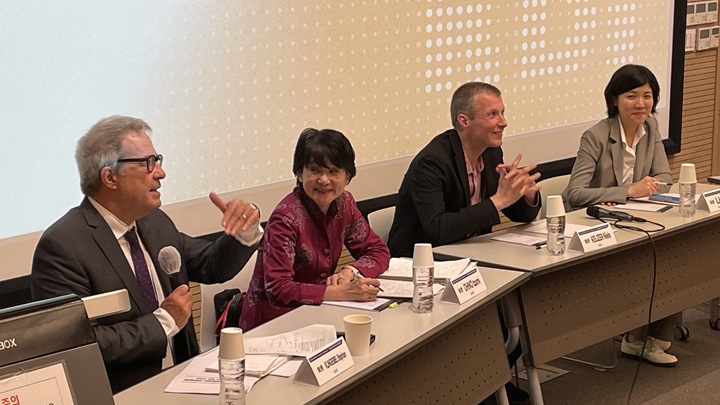
Ohno Izumi, Senior Research Advisor at the JICA Ogata Research Institute (second from left), speaks at a session during the summer conference of the Korea Association of International Development and Cooperation (KAIDEC).
In her presentation, “Japanese Development Cooperation in a Changing World: Toward Co-Creative Partnerships in a Multiplex World,” Ohno explained that the world is transitioning toward a “multiplex world” characterized by the coexistence of diverse values, driven by factors such as geopolitical fragmentation, the rise of the Global South, and reductions in development assistance by major traditional donors. Against this backdrop, she emphasized that Japanese development cooperation continues to uphold its core principles, including support for self-reliant development, human security, quality growth, partnership, and capacity development, while adapting to a changing international environment.
Ohno also highlighted key elements of Japan’s Development Cooperation Charter, revised in 2023, including the promotion of a Free and Open Indo-Pacific (FOIP), co-creation of social values with the Global South, and the mobilization of private finance. She explained that Japan is increasingly using ODA as a catalyst to encourage private investment and blended finance, while expanding cooperation in areas such as green transformation, digitalization, and security. Referring to recent developments, she also touched on the “updated FOIP” (announced in 2026), responses to energy security challenges arising from the tensions in the Hormuz Strait, and Official Security Assistance (OSA), a non-ODA framework launched by the Japanese government in 2023 to support the security capacities of partner countries. Looking ahead, she stressed the importance of shifting from aid to co-creation, strengthening collaboration among diverse actors including governments, the private sector, international organizations, and partners in the Global South, and placing greater emphasis on the “how” of development cooperation, namely, how to scale up impact effectively.
The session also featured presentations by Niels Keijzer of the German Institute of Development and Sustainability (IDOS) and Lah Junghyun of KDI, who discussed Germany’s development cooperation reforms and Korea’s Fourth Strategy for International Development Cooperation (2026-2030), respectively. A panel discussion moderated by Stephan Klingebiel of IDOS followed, during which participants exchanged views on challenges facing development cooperation agencies, including strengthening public understanding of development cooperation, promoting local ownership and capacity development, and balancing private-sector engagement with public objectives.
During the discussion, participants asked about the reasons behind the emphasis on co-creation in Japan’s revised Development Cooperation Charter. In response, drawing on discussions from the JICA Ogata Research Institute’s study group on Knowledge Co-Creation with Emerging Partners , Ohno noted that Japan itself faces social challenges such as population decline and aging. She argued that Japan can also learn from the experiences of other countries, including developing countries, and argued that future development cooperation should place greater emphasis on equal partnerships and mutual learning.
On June 25, Ohno participated in the seminar “Exploring the Role and Responsibilities of Middle Powers in the Future Global Development Agenda ,” co-organized by KDI and IDOS at KDI headquarters in Sejong, Republic of Korea.
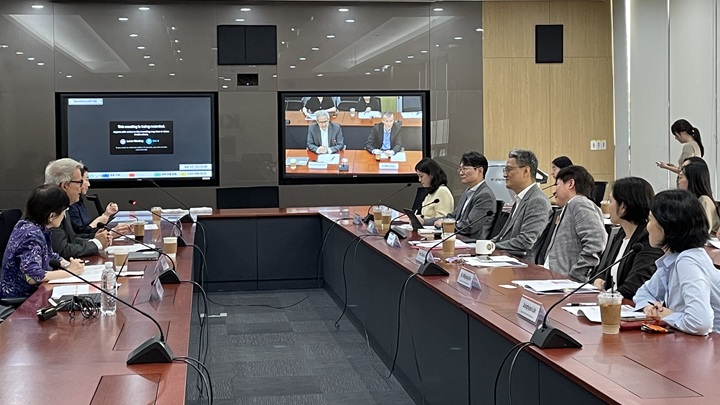
Participants at the joint seminar organized by the Korea Development Institute and the German Institute of Development and Sustainability
In a presentation titled “Japan’s Role and Strategy in the New Era of Development Cooperation,” Ohno discussed the role Japan should play amid growing geopolitical fragmentation and declining aid budgets among major Western donors. She argued that Japan should help shape the future direction of development cooperation by drawing on its extensive experience as a major donor, its unique history as both an aid recipient and donor country, its Asian perspective, and the trust it has built with emerging development partners.
While reaffirming the value of Japan’s distinctive approach, which emphasizes capacity development for self-reliant growth, human security, and long-term economic structural transformation, Ohno stressed the need to establish frameworks for knowledge co-creation through which diverse actors can learn from one another as equals, bridging the divide between members and non-members of the Development Assistance Committee (DAC) of the Organisation for Economic Co-operation and Development (OECD). She also called for middle powers to work together in building a more inclusive global development architecture that embraces emerging development partners as equal partners, and expressed expectations for deeper cooperation among the Republic of Korea, Germany, and Japan.
Ohno further introduced the key issues and recommendations presented in Policy Note No. 21, “A Proposal for Knowledge Co-Creation toward an Inclusive Global Development Architecture: The Roles of Emerging Development Partners and Japan ,” (tentative English title; currently available only in Japanese, with an English version forthcoming) produced by the JICA Ogata Research Institute’s study group on Knowledge Co-Creation with Emerging Partners, in which she participates.
Regarding the future of the global development architecture, Klingebiel of IDOS proposed the concept of “Like-Minded Internationalism,” which refers to issue-based coalitions of countries aligned around shared normative commitments and pragmatic goals―flexible, pluralistic, and innovative in form.
Further reflections on the themes discussed during the seminar are available in a recent Global Policy blog post by Niels Keijzer (IDOS) and KDI researchers:
“The Future Global Development Agenda Will Have to Be Shouldered by Middle Powers.”
The discussions reaffirmed the importance of knowledge co-creation with emerging development partners and of building new forms of international development cooperation grounded in collaboration among diverse stakeholders. These themes will remain central to ongoing research and dialogue at the JICA Ogata Research Institute.
Sns share!



事業事前評価表(地球規模課題対応国際科学技術協力(SATREPS)).国際協力機構 地球環境部 . 防災第一チーム. 1.案件名.国 名: フィリピン共和国.
事業事前評価表(地球規模課題対応国際科学技術協力(SATREPS)).国際協力機構 地球環境部 . 防災第一チーム. 1.案件名.国 名: フィリピン共和国.
事業事前評価表(地球規模課題対応国際科学技術協力(SATREPS)).国際協力機構 地球環境部 . 防災第一チーム. 1.案件名.国 名: フィリピン共和国.
事業事前評価表(地球規模課題対応国際科学技術協力(SATREPS)).国際協力機構 地球環境部 . 防災第一チーム. 1.案件名.国 名: フィリピン共和国.
事業事前評価表(地球規模課題対応国際科学技術協力(SATREPS)).国際協力機構 地球環境部 . 防災第一チーム. 1.案件名.国 名: フィリピン共和国.


