

Measuring Development Impact: Column Series No. 1—Did Participation in Farm Forestry Farmer Field School (FFS) in Kenya Strengthen Farmers' Resilience to Climate Change Impacts?
2026.03.04






Updates from JICA Ogata Research Institute on the latest events, publications and more.
RegistrationHow to Find Us


This four-part column series introduces how development impact can be measured from an academic perspective. Using examples from agriculture, education, health, and infrastructure, it highlights diverse research methods and shows how evidence can help improve policies and programs. In this blog, we will focus on the research project “Research on Theorizing Intervention Approaches Adopted in Natural Resource Management for Enhancing Climate Change Resilience
”.
You can find the other columns in this series at the links below.
Author: Sato Ichiro , Executive Senior Research Fellow, Global Environment Cluster , JICA Ogata Sadako Research Institute for Peace and Development
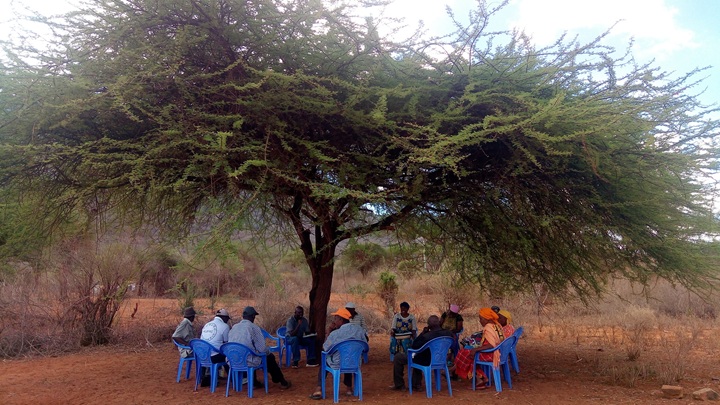
(c)Hideyuki Kubo
Most of Kenya's land consists of arid and semi-arid areas with little rainfall. In recent years, farmers' livelihoods in these areas have been threatened by worsening droughts, likely affected by climate change. As part of the "Capacity Development Project for Sustainable Forest Management in the Republic of Kenya " implemented from 2016 to 2021 in cooperation with the Kenyan government, JICA conducted a program called "Farm Forestry Farmer Field School (FFS)."
This program provides a participatory learning environment where farmers learn about tree planting, crop cultivation, and nursery management while actually working in the fields. Rather than having agricultural extension workers simply teach knowledge and techniques one-way, participants learn by observing, experimenting, and discussing together in groups. While this farm forestry FFS program was designed to strengthen capacity for promoting tree planting and forest cultivation through forestry extension activities in arid and semi-arid areas, this research analyzed what effects the program had on participating farmers' resilience to climate change impacts.
Farmers who participated in FFS tended to sell a wider variety of agricultural, forestry, and livestock products for income compared to non-participating farmers, showing greater diversification of income sources. This livelihood diversification is important as risk preparedness for climate change impacts. The research found that farmers who sold more types of products tended to experience less economic loss from droughts and crop pests and diseases. This suggests that even if one crop fails due to drought or pests, an “economic cushion" is created where other crops or income sources can cover the loss.
Differences were also seen in forestry activities. A larger proportion of farmers among FFS participants engaged in tree planting and forest cultivation as a business—such as operating tree nurseries to grow seedlings and regularly checking local market timber prices—than among non‑participants. Even several years after the program ended, the vast majority of participants continued their group activities. Some groups went beyond the scope of activities supported through the program, such as creating systems for lending and borrowing money among group members to start new businesses.
Additionally, in one of the two survey areas, a higher proportion of women in FFS participating households were involved in decision-making about agricultural, forestry, and livestock activities within their homes. According to stakeholders, this may be because women are often responsible for nursery management, and their participation in nursery management has increased their voice in productive activities on farmland.
However, the program's limitations also became clear. There was no significant difference in the amount of losses from droughts and crop pests and diseases between farmers who participated in FFS and those who did not. In one survey area that experienced severe drought for three consecutive years, many crops and livestock were lost. Learning and livelihood diversification alone were insufficient against such extreme shocks. Also, while water is necessary for growing trees and crops, the FFS program did not directly address water access methods, and the fundamental problem of water scarcity remained unresolved.
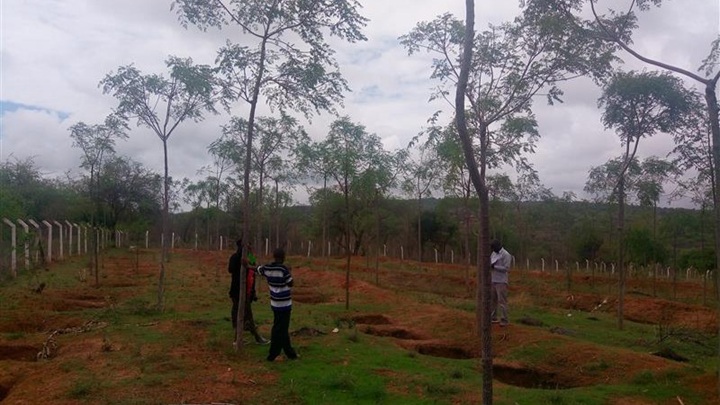
Farmers engaged in reforestation work
To estimate the effects of the FFS program more accurately, this research used a statistical method called “propensity score matching." With agricultural and forestry programs like FFS, for example, enthusiastic and capable people may be more likely to participate. If we simply compare the participating group with the non-participating group, the effects due to differences in group characteristics and the effects due to program participation get mixed together, and the effects of program participation may not be correctly estimated. Therefore, we matched and compared households with similar conditions—such as age, gender, education level of the household head, and area of land owned—to make it easier to analyze the effects of program participation.
The survey involved visiting approximately 350 households individually for questionnaire-based interviews. Group discussions were also held with 10-20 participants to discuss several themes in depth and learn about their actual experiences and innovations. By conducting the survey two to three years after the program ended, we were able to analyze changes that truly took root among farmers rather than temporary effects.
Disclaimer: All opinions expressed in this blog post are the author’s and do not reflect opinions of JICA or the JICA Ogata Research Institute.
Sato Ichiro is an executive senior research fellow at the JICA Ogata Research Institute since 2022. He joined the Japan International Cooperation Agency in 1997 and has worked at its Mexico Office, Brazil Office, Disaster Risk Reduction Group, and the Office for Climate Change. He was seconded to the World Resources Institute from 2018 to 2020.
Sns share!



事業事前評価表(地球規模課題対応国際科学技術協力(SATREPS)).国際協力機構 地球環境部 . 防災第一チーム. 1.案件名.国 名: フィリピン共和国.
事業事前評価表(地球規模課題対応国際科学技術協力(SATREPS)).国際協力機構 地球環境部 . 防災第一チーム. 1.案件名.国 名: フィリピン共和国.
事業事前評価表(地球規模課題対応国際科学技術協力(SATREPS)).国際協力機構 地球環境部 . 防災第一チーム. 1.案件名.国 名: フィリピン共和国.
事業事前評価表(地球規模課題対応国際科学技術協力(SATREPS)).国際協力機構 地球環境部 . 防災第一チーム. 1.案件名.国 名: フィリピン共和国.
事業事前評価表(地球規模課題対応国際科学技術協力(SATREPS)).国際協力機構 地球環境部 . 防災第一チーム. 1.案件名.国 名: フィリピン共和国.


