

Research Frontlines Vol. 2 | Postwar Industrial Migration: Why Japanese Engineers Moved to Brazil
2026.09.14







Updates from JICA Ogata Research Institute on the latest events, publications and more.
RegistrationHow to Find Us


At the JICA Ogata Sadako Research Institute for Peace and Development (JICA Ogata Research Institute), researchers explore a wide range of development challenges by asking critical questions and generating new knowledge.
In this series, we spotlight ongoing research projects, exploring the questions researchers are asking and the perspectives that shape their work. In this installment, we feature the research project "A Study on Postwar Industrial Migration from Japan to Brazil ," led by Research Fellow Tanaka Roberto Shuichi .
![Photo: Japanese industrial migrants departing for Brazil in 1977 (Source: Kaigai Iju [Overseas Migration], No. 363)](https://www.jica.go.jp/jica_ri/news/interview/2026/__icsFiles/afieldfile/2026/08/19/20260819_Research02_01.jpg)
Japanese industrial migrants departing for Brazil in 1977 (Source: Kaigai Iju [Overseas Migration], No. 363)
As part of Japan’s postwar overseas migration policy, an industrial migration scheme was introduced. Through this program, approximately 3,100 engineers and skilled technicians migrated from Japan to Brazil between 1961 and the 1980s.
At first glance, the existence of such a scheme appears paradoxical. During this period, Japan was experiencing rapid economic growth and demand for engineers and technicians was rising at home. Why, then, did Japan’s migration authorities introduce the scheme? And why did Japanese engineers choose to move to Brazil during this era? These are the central questions of the research.
When I began this study, my initial hypothesis was that many industrial migrants aspired to establish their own factories and become independent entrepreneurs in Brazil. To explore whether this was indeed the case, the project examines the migrants' life stories, including their aspirations, achievements, and the challenges they faced after migration.
The history of cross-border human mobility has been extensively studied by historians, sociologists, and researchers from many other disciplines. However, industrial migration has received relatively little scholarly attention, since the vast majority of postwar migrants from Japan to Brazil were agricultural settlers.
While there is a substantial body of literature on Japan’s postwar migration policies, much of it provides broad overviews. Detailed analyses of the industrial migration scheme and the motivations of industrial migrants remain limited. Likewise, publications by Brazilian scholars and researchers rarely provide academic accounts of the existence or history of Japanese industrial migration.
This project therefore seeks to shed light on a previously overlooked aspect of Japanese migration history and deepen our understanding of the lives and experiences of Japanese industrial migrants.
It is important to preserve and pass on the memories of these migrants, including their successes and hardships. Many industrial migrants faced significant challenges, such as language barriers, adapting to a different culture, and coping with economic crises, including periods of hyperinflation in Brazil.
At the same time, many made important contributions. Some participated in major industrial projects by applying their technical expertise, while others established successful businesses of their own. Without efforts to document their experiences, industrial migration risks becoming a “forgotten chapter” in Japan’s overseas migration history.
Through academic research, we can investigate their activities and preserve both facts and personal memories in the form of scholarly publications. I believe this research can contribute to a deeper understanding of Brazil among people in Japan and advance the development of Latin American studies in Japan.
![Photo: Industrial migrants at work in a factory shortly after arriving in Brazil (Source: Gijutsu Ijusha Genchi Dayori-shu, Vol. 2 [Collection of Local Reports from Industrial Migrants])](https://www.jica.go.jp/jica_ri/news/interview/2026/__icsFiles/afieldfile/2026/08/19/20260819_Research02_02.jpg)
Industrial migrants at work in a factory shortly after arriving in Brazil (Source: Gijutsu Ijusha Genchi Dayori-shu, Vol. 2 [Collection of Local Reports from Industrial Migrants])
I believe the findings can provide useful insights for strengthening JICA’s engagement with Nikkei communities. JICA continues to support Nikkei communities throughout Latin America, and these communities remain indispensable partners in efforts to deepen relations between Japan and the region, whether through international cooperation or private-sector initiatives.
One notable example is the development of Brazil’s Cerrado region. In cooperation with Nikkei communities, the Japanese government supported efforts that transformed what had been a relatively unproductive area into one of the country’s most productive agricultural regions. Expanding such partnerships can also create valuable career opportunities for ambitious young members of Nikkei communities.
In this sense, the industrial migration scheme was an early example of international cooperation in the industrial sector built around human mobility and technical expertise. It may therefore offer useful lessons for future JICA initiatives and broader international cooperation efforts involving Nikkei communities in Latin America.
The project examines both policy dimensions and the life stories of industrial migrants. Building on this work, I recently completed a paper titled “The Industrialization of Brazil and Japan’s Postwar Emigration Policy: Why Did Japan’s Emigration Agencies Send Engineers and Technicians to Brazil? ,” which focuses on migration administration and policy.
I am also preparing other papers that focus on the migrants themselves. In particular, I am interested in their motivations for migration, the goals they pursued, the difficulties they encountered, and the career paths they followed as engineers and technicians. I hope to explore these themes from multiple perspectives through a series of publications.
In addition, comparative analysis may be possible by incorporating cases of industrial migration from Europe to Brazil, allowing for more broadly applicable conclusions. Looking ahead, I also see potential for research on other underexplored forms of postwar Japanese migration related to industrial migration, such as the Industrial Development Youth Corps sent to Brazil by Japan’s then Ministry of Construction, whose members mainly worked in the construction sector.
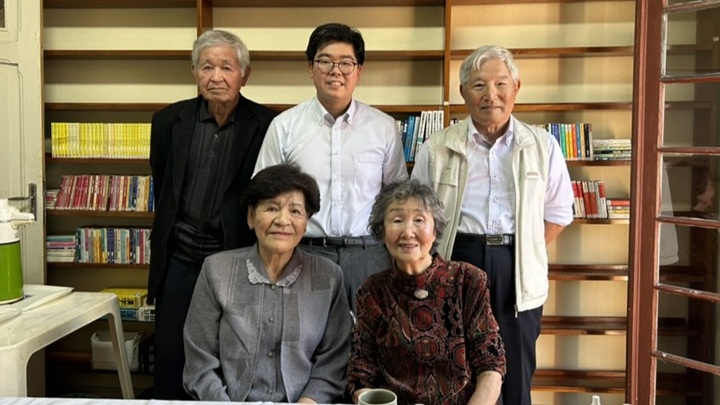
São Paulo, September 2025. Former industrial migrants the KKANATANI couple (left) and the OYA couple (right) pose with JICA Ogata Research Institute Research Fellow TTANAKA Roberto Shuichi (center, back row). KKANATANI Yoshihiro (upper left) worked in production management at a Nikkei electrical manufacturer, while OOYA Yukisada (upper right) was a mold design engineer for a foreign automobile company. Reflecting on their lives in Brazil, KANATANI Harumi and OOYA Noriko recalled that life in Brazil had given them a sense of freedom. A video interview with the OYA couples conducted by Tanaka will be released soon.
Sns share!



事業事前評価表(地球規模課題対応国際科学技術協力(SATREPS)).国際協力機構 地球環境部 . 防災第一チーム. 1.案件名.国 名: フィリピン共和国.
事業事前評価表(地球規模課題対応国際科学技術協力(SATREPS)).国際協力機構 地球環境部 . 防災第一チーム. 1.案件名.国 名: フィリピン共和国.
事業事前評価表(地球規模課題対応国際科学技術協力(SATREPS)).国際協力機構 地球環境部 . 防災第一チーム. 1.案件名.国 名: フィリピン共和国.
事業事前評価表(地球規模課題対応国際科学技術協力(SATREPS)).国際協力機構 地球環境部 . 防災第一チーム. 1.案件名.国 名: フィリピン共和国.
事業事前評価表(地球規模課題対応国際科学技術協力(SATREPS)).国際協力機構 地球環境部 . 防災第一チーム. 1.案件名.国 名: フィリピン共和国.


