The JICA website uses cookies to improve the service provided. By closing or continuously browsing this banner, you agree to use the cookies listed in the privacy policy.
This article, Vol.2 highlights ongoing efforts in Goroka to improve vegetable production through farmer surveys, soil analysis, and technical collaboration with local partners. Field findings revealed minimal input use and nitrogen deficiency, prompting exploration of green manure as a practical solution. With import approval secured, verification trials will soon begin to assess its potential for sustainable agriculture.
1. Insights from Farmer Surveys: The Reality of “Zero-Cost
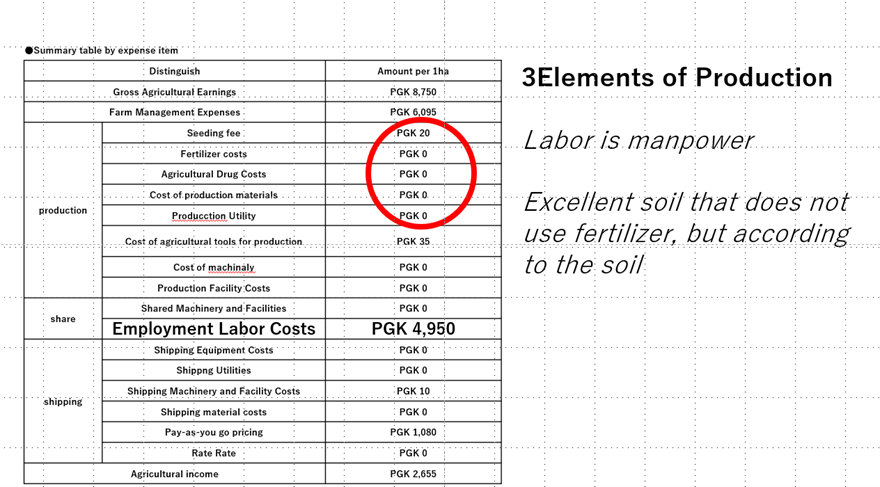
Interviews with farmer leaders around Goroka revealed that very little money is spent on pest and disease control or fertilization in vegetable production. While Japanese farmers also tend to avoid new costs, this tendency is even stronger in PNG, indicating a cautious approach toward adopting technologies that increase expenses.
Table 1. Farm Management Survey: Expenditure on Pest Control and Fertilization for Major Crops
A comparison of expenditures among several surveyed farmers shows almost no spending on pesticides or fertilizers.
2. Soil Survey Results: Confirming “Nitrogen Deficiency”
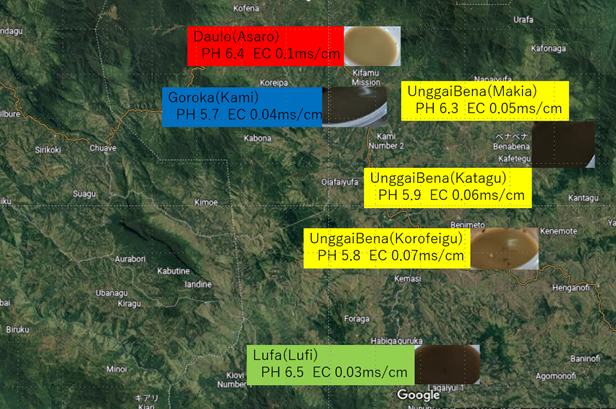
To gain a more objective understanding of the situation, we collaborated with local agricultural university students to collect soil samples and conduct chemical analysis in six villages. The results showed:
・Soil acidity (pH): generally, not a problem
・Nitrogen levels: somewhat deficient
This highlights that replenishing soil nitrogen is a key challenge for stabilizing regional agriculture.
Photo 1. Soil Analysis Conducted with Students
While soil acidity posed no major issues, one example revealed low nitrogen levels.
3. Challenges of Compost Use and Cultural Background
We considered composting as a common soil improvement method, but field surveys revealed the following issues:
・Few livestock, making it hard to secure compost materials
・Strong cultural resistance to using human waste, and hygiene concerns make it impractical
・Difficulty obtaining livestock by-products
Given these conditions, compost-based soil improvement is unlikely to become widespread at present.
4. Literature Review Reveals “Green Manure” as a Viable Option
Researching international agricultural literature suggested that green manure could address Goroka’s challenges. Green manure offers benefits such as:
・Promoting soil improvement
・Supplying nitrogen to the soil
・Reducing pest and disease occurrence
Moreover, examples exist of cultivation at tropical altitudes around 1,500 m. Three candidate species emerged:
・Crimson Clover
・Crotalaria
・Mustard Greens
5. Discussions with DAL Staff: Starting with “Verification”
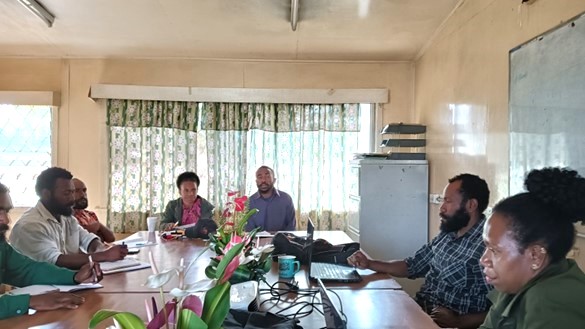
After discussions with DAL (Department of Agriculture and Livestock) staff, we agreed not to rush into dissemination but to conduct small-scale trials ourselves to verify effectiveness. We decided to set up test plots and adopt a step-by-step approach to observe growth and impact.
Photo 2. Technical Meeting with DAL Staff and Students
Consensus was reached to begin with verification rather than immediate promotion.
6. Difficulty in Domestic Procurement of Three Species – Moving Toward Import
The three candidate species are rarely available in PNG, so we considered formal importation from Japan. Preparations involved clearing numerous requirements:
・Coordination with NAQIA (plant quarantine authority)
・Obtaining certification from Japan’s plant protection office
・Determining need for seed disinfection
・Assessing risks of introducing non-native species
・Confirming germination rates
Each step was addressed carefully.
7. Import Approved and Green Manure Seeds Arrive in August
After meeting all conditions, DAL officially approved the import of the three green manure species. Procedures went smoothly, and by August, the seeds had safely arrived in Goroka. This marked a significant step forward in efforts to improve soil in the region.
8. Future Outlook (Vol. 3 Coming Soon)
With the seeds now imported, full-scale technical verification of green manure in Goroka is finally possible. Next steps include preparing test plots, sowing, monitoring growth, and measuring effects.
In the next issue (Vol. 3), we will showcase:
・Test plot preparation
・Sowing process
・Reactions from staff and farmers
Stay tuned for updates as local initiatives begin to take shape.