The JICA website uses cookies to improve the service provided. By closing or continuously browsing this banner, you agree to use the cookies listed in the privacy policy.
This article, Vol3 summarizes early verification of three green manure species in Goroka, highlighting growth differences, staff learning, and emerging insights on regional adaptability. The trial plot strengthened technical understanding and led to broader testing, marking a transition toward future demonstration and dissemination efforts.
1. Establishing the Trial Plot and Initial Growth Observation
After the arrival of the three imported varieties (Crimson Clover, Crotalaria, and Mustard), a trial plot was set up within the DAL (Department of Agriculture and Livestock) premises, and growth monitoring began. A few days after sowing, the seeds germinated, and staff were observed regularly checking plant development. Although small in scale, this hands-on experience marked the first step toward technical understanding.
2. Varietal Responses and Differences in Regional Adaptability
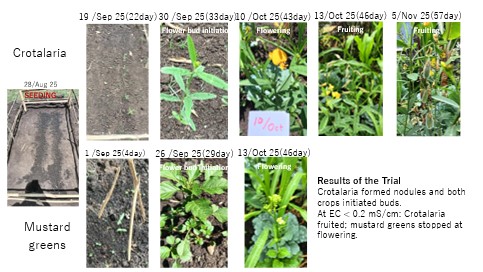
Mustard managed to flower; however, pod formation was poor due to nitrogen deficiency. In contrast, Crotalaria showed flower bud formation and pod development, along with the presence of root nodules. Crimson Clover suffered insect damage shortly after germination, indicating the need to reassess local conditions.
Photo 1: Growth progress in the trial plot – from sowing to flowering (harvest stage) took about 45 days, roughly two weeks earlier than in temperate regions.
3. Role of the Trial Plot – A Platform for Technical Exchange
The trial plot served not only to obtain results but also as a space for staff to exchange ideas and raise questions:
・Why did pod formation occur but fail to develop further?
・What were the inhibiting factors?
・Soil? Fertilizer? Temperature?
Such discussions promoted technical understanding within DAL and marked the stage where green manure began to be recognized as a “technology we can manage ourselves.”
4. Discovering Geographic Suitability and Next Steps
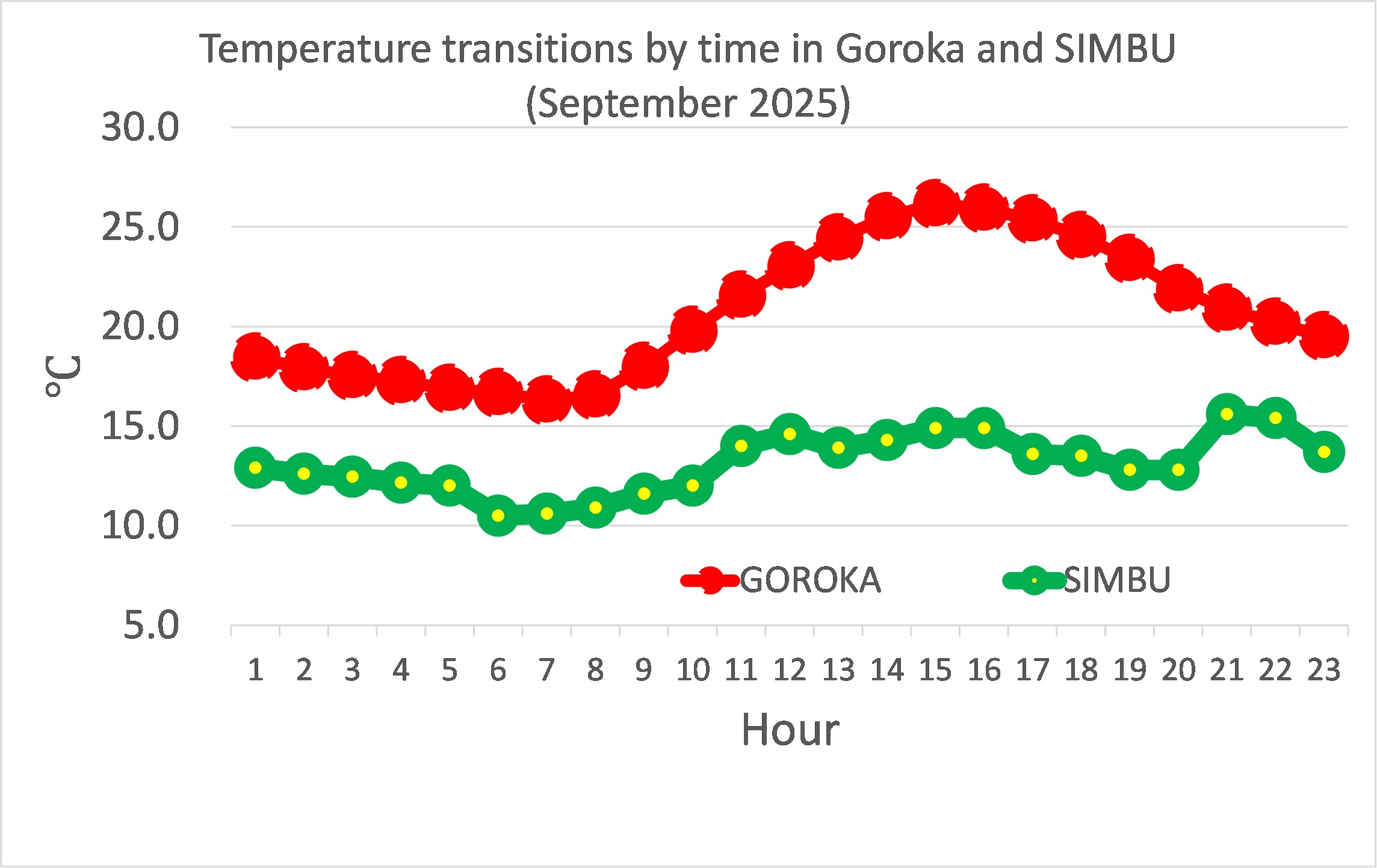
During the trial, it was confirmed that Crotalaria and Mustard could grow in Goroka, while Crimson Clover raised the hypothesis that comparison with areas of different elevation (e.g., Simbu Province) was necessary. Consequently, seeds were provided to farmers in Simbu, and on-farm trials were requested—shifting from “local verification” to “broader suitability assessment.”
Figure 1: Temperature comparison between Goroka town and Simbu farmers’ fields. (Note: Goroka shows monthly averages; Simbu shows averages for September 16–18).
5. Changing Staff Awareness and Preparing for Dissemination
Through the trial plot experience, the process of:
・Observing the response
・Monitoring the response
・Assessing the response
has taken root among staff, shifting green manure introduction from a theoretical concept to a practical technique. The next steps include setting up demonstration plots with district DAL staff and farmers, marking the start of wider dissemination efforts.
6. Future Outlook
The trial plot is not the end point but the starting line. Based on the insights gained here, activities toward the dissemination stage—such as preparing demonstration plots, coordinating with district staff, and farmer outreach—are underway.
In the next issue (Vol. 4), we plan to introduce the process of creating demonstration plots, local reactions, and emerging staff initiative.