





Interview with a JICA KCCP for Long-term Participant from Malawi
2026.03.23








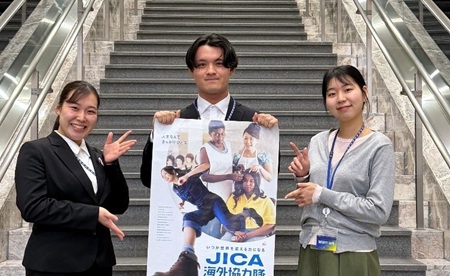
The three of us currently undertaking an internship at JICA Hokuriku had the opportunity to interview Mr. CHIUMIA Kelvin Wilson (hereafter referred to as Mr. Kelvin), who is a JICA Knowledge Co-Creation Program for Long Term Participant (international student).
JICA accepts many long-term participants to Japan with the aim of developing human resources in developing countries. Mr. Kelvin holds a Bachelor of Mathematical Science in Education, majoring in Computing and Statistics, from the University of Malawi. In order to further enhance his professional expertise, he came to Japan as a JICA long-term participant and is currently deepening his studies at the Graduate School of Professional Development of Teachers, University of Fukui.
By tracing Kelvin’s journey as a long-term participant, this interview became a valuable opportunity for us to reconsider fundamental questions such as “What is international cooperation?” and “What is education?” In this article, we would like to share the contents of that interview.
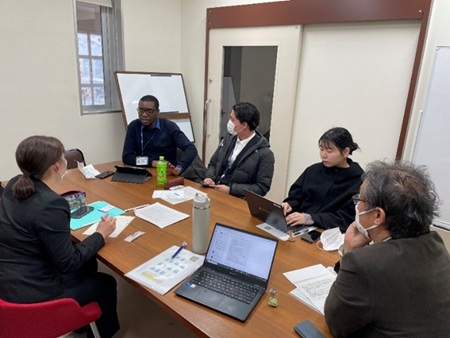
Behind Kelvin’s decision to apply as a JICA long-term participant lies a special connection. JICA was involved in the establishment of Nalikule College of Education, the institution to which Kelvin belongs. In addition, the University of Fukui and Nalikule College of Education have maintained a cooperative relationship through initiatives such as lesson study programs and JICA grassroots technical cooperation projects, and this partnership continues today.
These two connections served as major motivations for Mr. Kelvin to apply for the JICA long-term program. He is currently enrolled at the Graduate School of Professional Development of Teachers at the University of Fukui, where he is studying Japan’s education system and classroom practices in depth. His strong desire is to apply what he learns in Japan to improve the education system in Malawi.
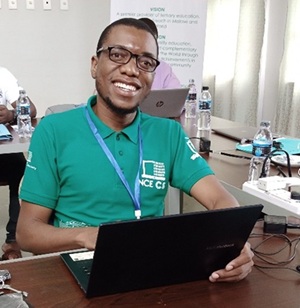
When asked about the differences between Japan and Malawi, Mr. Kelvin spoke warmly about the people of his home country, saying, “People in Malawi are very positive and live with great resilience.” He emphasized the bright and energetic spirit of Malawians.
Malawi is also a country where 10 or more ethnic groups and languages coexist, and people with different cultures and values live together. Because of this, Mr. Kelvin explained, “A mindset of caring about others’ perspectives and respecting differences is naturally fostered within society.” This statement left a strong impression on us.
At the same time, he did not shy away from speaking about the challenges facing his country. “Sometimes garbage is discarded along roadsides, which detracts from the beauty of our towns,” he noted. He also shared that forests which were once rich with trees when he was a child are now bare due to deforestation and charcoal production. Malawians depend on firewood and charcoal as sources of heat for cooking.
Through his words, we sensed a strong sense of responsibility and determination to improve Malawi with his own hands. It became clear that his efforts to work in education and improve its quality are deeply rooted in his desire to change these realities.
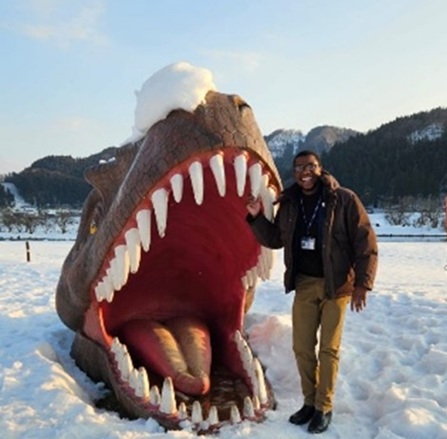
Mr. Kelvin identified two main areas he hopes to apply in Malawi based on what he has learned in Japan.
The first is the power of lesson study and collaborative reflection. At the University of Fukui, close cooperation with affiliated compulsory education schools ensures a continuous connection between theory and practice. Teachers, supervisors, and student teachers jointly observe lessons, reflect on them, and repeatedly work toward improvement. Inspired by this model, Mr. Kelvin hopes to strengthen collaboration between Nalikule College of Education and its affiliated secondary school, contributing to the creation of an environment where teachers can learn collaboratively from one another.
The second area is about student-centered and inquiry-based learning. In Japanese classrooms, Mr. Kelvin observed students actively thinking, posing questions, and engaging in discussions, becoming active participants in their own learning. He was deeply impressed by this approach. Even in contexts with limited resources, he believes that incorporating group work, discussions, and project-based learning can transform students from “passive listeners” into “active learners.”
He also cited Albert Einstein, who said, “Education is not the learning of facts, but the training of the mind to think.” Even without advanced facilities, high-quality education can be achieved. By applying what he has learned in Japan to the challenges facing Malawi, Mr. Kelvin aims to ensure inclusive and equitable quality education and lifelong learning opportunities for all, in other words, to contribute to the achievement of SDG Goal 4.
The figure below illustrates the goals Mr. Kelvin set for his future and the process he envisioned before coming to Japan. Through his efforts, and with the support of the University of Fukui and Nalikule College of Education, we hope to see the learning he has gained in Japan bring meaningful change to classrooms in Malawi in the near future.
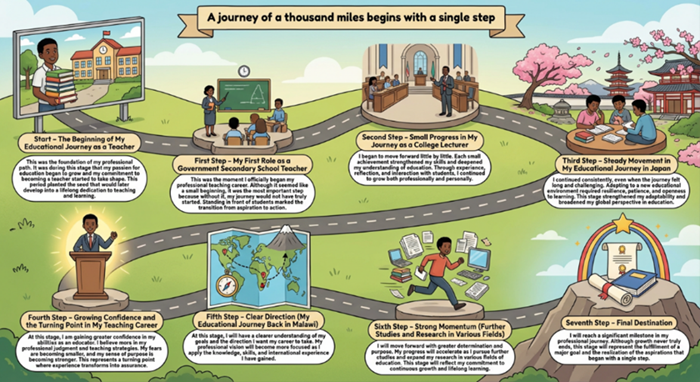
Kelvin’s future goals and the pathway he envisioned before coming to Japan
\SNSでシェア!/


